Dusk
The thing about preparing for a fight you know is coming is that the preparation is worse than the fight.
The fight is fast. Even when it doesn't feel fast — even when every second stretches into a small eternity of terror and teeth — it's over in minutes, and then it's done, and you're either alive or you're not, and either way you've stopped waiting. But the preparation. The preparation is where you sit with the full, unedited understanding of what you're preparing for, and the preparation takes as long as it takes, and there is no fast way through it.
I spent two days turning Edric's farm into something a generous observer might call a defensive position and an honest one would call a desperate mess.
Sharpened stakes driven into the ground along the north fence — the weak side, where the wolves had broken through — angled outward at roughly the height of a wolf's chest. Twenty-three of them, because that's how many suitable branches I could find in the woodpile and the edge of the forest before Edric stopped me from going further into the trees. He was right to stop me. The trees were not safe. Nothing was safe. But the yard could be less unsafe, and that was the best I had.
A fire trench: a shallow channel dug along the base of the north fence and filled with oiled straw and dry kindling, with a torch ready in a bracket on the fence post. Wolves don't like fire. I'd read that in the Underpeak library, in a surface ecology text that Professor Grumthar had used as a doorstop until I'd rescued it. The text had been written about normal wolves, of course. Not the kind with too many teeth and eyes like dead moons. My confidence in the literature was not what it might have been.
The fence itself I reinforced with everything available. Spare planking from the barn. Rope lashing at the joints. A second rail along the bottom where the original had rotted. It wouldn't stop them — three wolves had punched through oak like parchment — but it would slow them. Slow meant time. Time meant Rensting.
Rensting leaned against the door frame of the farmhouse, where I'd placed it within arm's reach.
Mila kept trying to touch the rune.
"Varm," she said, reaching for it again. I caught her hand — gently, because Mila didn't respond well to being told no and even worse to being told no by someone whose beard she considered public property. She scowled at me with the focused indignation of a child who has been denied something she considers rightfully hers.
"Varm," she insisted, pointing at the rune. Warm.
I touched it. Cold iron. The same temperature as the shaft, as the afternoon air, as everything else. I felt nothing.
"Not warm," I said, in my halting approximation of their language.
Mila looked at me with an expression that communicated, with devastating clarity, that I was wrong and possibly stupid. Then she touched the rune again — just her fingertip, barely brushing the carved surface — and smiled.
"Varm," she said, with the unshakeable confidence of someone who has never once considered the possibility that she might be mistaken about anything.
I let it go. I had stakes to sharpen.
Edric helped. Grudgingly, in the way he did everything involving me — with the air of a man who had decided to cooperate not because he trusted me but because the alternative was worse. He drove stakes while I cut points, and we worked in a silence that had become, over the past week, almost comfortable. Not friendly. Not warm. But the silence of two people who understood what was coming and had agreed, without discussing it, to face it together.
Halla brought us water at intervals. She still kept her distance from me, but the distance was shrinking — down from twenty feet to five, and yesterday she'd handed me a leather strap for Rensting's binding without being asked, which was practically an embrace by Halla's standards. At the rate we were going, she might look me in the eye by midsummer. Assuming we lived that long.
Ren helped where he could, dragging branches for the fire line with a grim focus that looked wrong on a ten-year-old's face. He'd been quieter since the last attack. The scratches on the barn wall had continued — eight, nine, ten — but he made them without ceremony now. Just keeping count. Waiting.
The boar watched from its usual position at the edge of the yard. Closer than it used to be — close enough that Mila could have reached it, which she tried, regularly, and the boar tolerated with a patience that bordered on resignation. It sat in the late afternoon sun with its broad head low and its small eyes tracking everything: the stake line, the fire trench, the tree line beyond the fence. Its ears swiveled constantly, catching sounds I couldn't hear.
I noticed it watching the woods more and more as the day wore on. Its ears would flatten. Its bristles would rise along its spine in a dark ridge. Then it would settle again, but the settling took longer each time.
It knew.
They came at dusk.
I was at the north fence with Rensting in both hands when the light began to fail. The sun dropped behind the hills and the shadows stretched across the farmyard like reaching fingers, and in the space between one breath and the next, the tree line changed. Not a sound. Not a movement I could point to. Just a shift — the way a room feels different when someone is standing behind you.
Edric was at the farmhouse door with his axe. Halla had the children inside. The fire trench was ready — oiled straw, dry kindling, the torch burning in its bracket.
I waited. My hands were sweating on Rensting's shaft. My heartbeat was doing something ambitious with tempo.
The first wolf stepped out of the tree line like it was arriving for an appointment.
Calm. Measured. Its pale eyes swept the farmyard — the stakes, the trench, me — with an intelligence that made my skin crawl. It saw the defenses. It assessed them. Then it sat, just beyond the stake line, and waited.
A second appeared. A third. Then more — shapes detaching from the shadows between the trees, spreading along the forest edge in a line that kept growing. I counted. Five. Seven. Nine.
Nine.
There had been three before.
"Ni," Edric said from the doorway. His voice was flat.
I didn't need the translation. I could count. Nine wolves, each of the wrong kind — too big, too patient, too pale — with the overcrowded teeth and the dead-lamp eyes. They arranged themselves in a line at the edge of the trees like an audience taking their seats, and the largest of them — a massive grey with a ragged scar across its muzzle — began to move.
Not a charge. A walk. It walked along the stake line, head low, studying the sharpened wood with the focused attention of a craftsman inspecting work. When it reached the end, it turned and walked back. Testing. Probing. Looking for the weakness.
They all started moving at once.
It wasn't a charge. It was a maneuver. Three wolves hit the stake line from the front — feinting, lunging, drawing attention north. Two circled east. Two circled west. And the last two — the scarred grey and one nearly as large — came straight at the joint where the old fence met my reinforced section. The seam. The weakest point.
I'd expected fury. I got tactics.
"Eld!" I shouted at Edric. Fire. One of the forty words I was certain about.
The torch arced across the yard and hit the trench. The oiled straw caught with a whump and a line of flame leaped up along the north fence. The wolves at the stake line recoiled — not panicking, not fleeing, just adjusting. Pulling back to a distance that said noted rather than defeated. The fire bought seconds. Maybe a minute.
The two at the joint didn't stop.
The scarred grey hit the fence where old planking met new and the wood screamed. Not broke — screamed, a tearing shriek of nail and grain as the board wrenched half free. The second wolf shouldered through beside it, widening the gap, and suddenly there was an opening where there hadn't been one and two shapes were pouring through it into the yard with those pale eyes and those impossible teeth and—
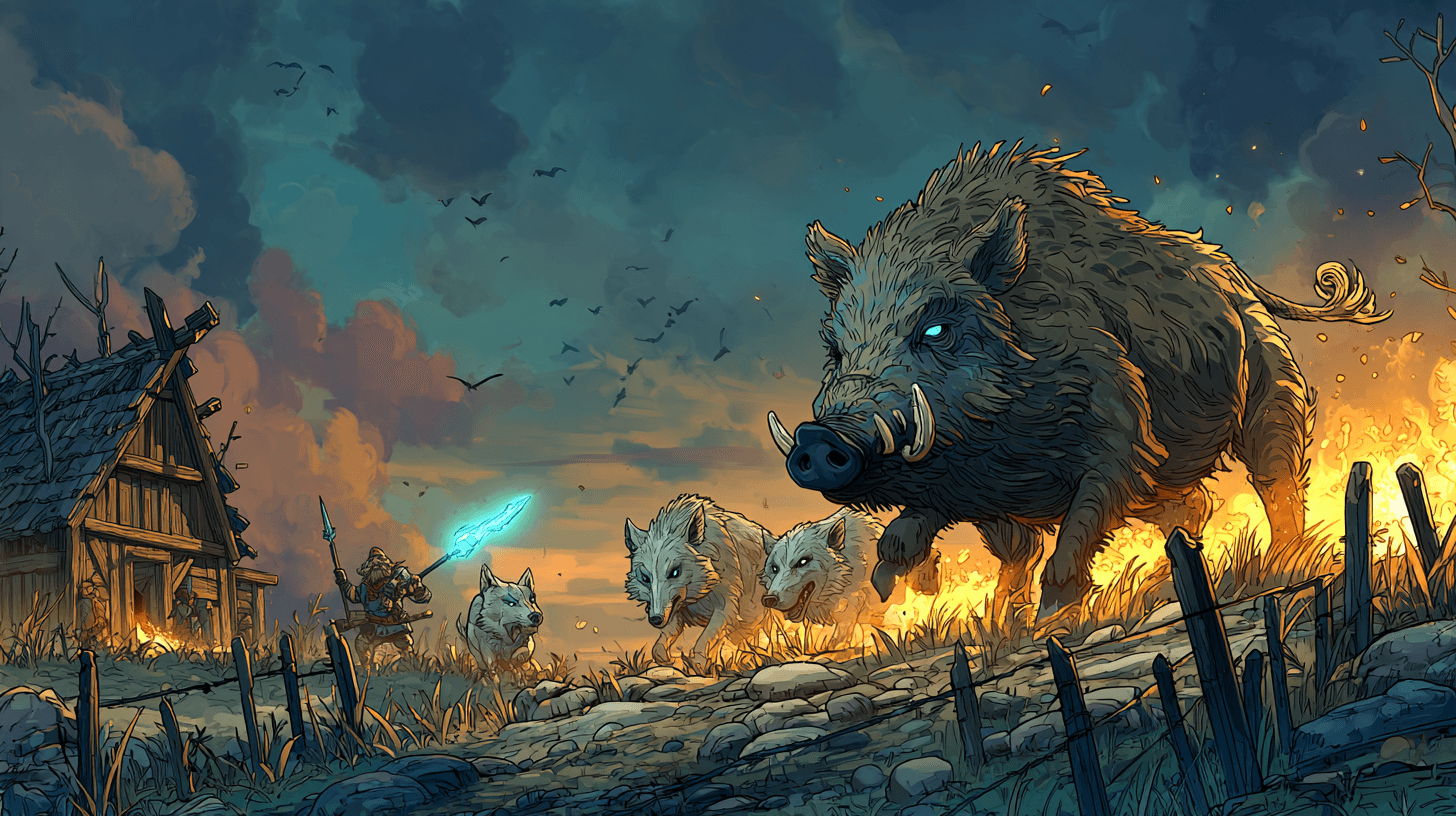
The boar hit them like a landslide.
I didn't see it start. One moment it was at the edge of the yard. The next it was there — four hundred pounds of bristle and fury slamming into the scarred grey broadside with an impact I felt through the soles of my boots. The wolf went sideways, all four legs off the earth, and the boar was already turning, already moving, tusks sweeping in a low vicious arc that caught the second wolf across the shoulder and opened it up in a spray of dark blood.
The grey recovered. Faster than anything that size should recover. It lunged for the boar's flank — jaws wide, those overcrowded teeth catching the last of the dusk light — and the boar pivoted. Not fast. Fast is what you call something that moves quickly and loses control. The boar moved with the terrifying momentum of something that is heavy and angry and has decided exactly where it's going. The wolf's jaws snapped shut on bristle and hide instead of throat, and the boar drove forward, tusks down, pushing the wolf back toward the gap.
I realized, in the space of about two seconds, what was happening.
The boar was holding the breach.
Not randomly. Not by accident. It had placed itself in the gap — the single point where wolves were getting through — and it was holding it. Every wolf that tried the fence break had to come through the boar first, and the boar was not moving. It took hits. Teeth in its flanks. Claws raking its shoulders. And it did not move. It planted those stubby, powerful legs and took everything they threw at it and held.
The boar wasn't fighting the wolves to kill them. It was fighting to stop them. To pin them, stagger them, hold them in place.
To give me something to hit.
I stopped thinking and started hitting.
Rensting was reach. Rensting was precision. Behind the boar I had both — a clear line of attack at wolves that were pinned, staggered, or trying to climb past the wall of bristle and tusk that blocked their way. I thrust over the boar's back at a wolf trying to scramble across. The five-sided point punched through the wolf's throat and it went down with a sound like tearing cloth. I pulled free, reset, thrust again — around the boar's flank this time, catching a wolf mid-lunge in the ribs. The point went deep. The wolf screamed.
Something screamed differently.
I didn't notice at first. I was occupied — being too busy trying not to die occupies most of your attention and leaves very little room for aesthetic observation. But the wolves I hit with Rensting reacted wrong. Not just the pain. It was the quality of the scream. Higher. Clearer. Like something was being stripped away — a layer peeled off — and what was underneath was just... an animal. A hurt, confused, ordinary animal, suddenly wondering how it got here and why everything hurt.
Mila screamed something from the farmhouse window. I didn't catch it — I was extracting Rensting from a wolf that had strong opinions about my continued existence — but Edric, at the door, went still. He was staring. Not at me. Past me. At Rensting.
At the rune.
I had other things to worry about. Like the wolf currently testing whether dwarf faces were edible.
The boar caught that one. Tusks under the ribs, lift, throw. The wolf hit the ground three feet away and didn't get up. The boar was bleeding from everywhere — a dozen wounds, maybe more, bites and scratches that matted its dark bristles with darker blood — and it didn't seem to care. Or it cared the way a stone wall cares about rain: with absolute, immovable indifference.
We fought. I don't know for how long. Time does strange things when something is trying to kill you — stretches and compresses and stops meaning what it usually means. There were moments that lasted hours: a wolf lunging, my arms swinging Rensting around, the tip finding its mark. And there were minutes that vanished between heartbeats: wolves coming, the boar meeting them, me striking, wolves falling, more coming.
We fell into a rhythm. The boar crashes in. I follow through. The boar absorbs. I finish. No coordination, no plan, no signal — just two creatures who had apparently decided, without discussing it, that this was how they fought. Together. Him and me. Tank and sting.
Then it stopped.
The remaining wolves pulled back. Not scattered — pulled back. Together. In formation. They disengaged from the boar, from the fence line, from the fire, and retreated up the hill toward the trees as a group. The scarred grey — still alive, bleeding from a tusk wound in its side — paused at the forest edge. It turned those pale, dead-moon eyes back toward the farm.
Toward me.
Then it was gone. They all were. Together. Uphill. Organized. Like they were falling back to a position. Like they were protecting something.
I stood in the gap in the fence, breathing hard, Rensting dripping, and stared after them.
The boar stood in front of me. Still between me and the tree line. Still bleeding from a dozen wounds. Still standing.
It huffed. A low, rumbling sound, deep in its barrel chest.
"Yeah," I said. "I know."
Behind me, Edric said something to Halla. His voice was strange — not scared, not relieved. Wondering.
Mila's face appeared in the window again. She was staring at Rensting with eyes the size of saucers.
"Ljus!" she shouted. "Borin, ljus!" Light.
I looked down at Rensting. The rune was dark. Cold iron, same as always.
But on the bodies of the wolves — four of them, sprawled in the yard and in the gap — the wounds I'd made looked different from the boar's kills. The boar's wounds were torn, ragged, brutal. Mine were clean. Surgically clean. And around the edges of each one, the flesh had a faint discoloration — pale, almost white, as if something had been burned away.
I didn't understand it. I filed it away, like the too-long teeth, like the pale eyes, like a rune I didn't carve and a song I didn't learn. Another thing I couldn't explain, in a growing collection of things I couldn't explain.
I looked at the dark hillside.
What are you protecting?