The Lair
I went after them at dawn.
This was not, I want to emphasize, a decision I arrived at through courage. Courage is what you have when you choose to face danger because you believe in something greater than yourself. What I had was the cold, practical understanding that if I didn't find where the wolves were coming from, they would keep coming. Next time there might be more than nine. And the time after that, the fence wouldn't hold. And the time after that—
Well. There wouldn't be a time after that.
Edric tried to come with me. He stood at the door with his axe and said several things I understood maybe a third of. The words I caught were varg, farlig — dangerous, Ren had taught me that one along with an impressively detailed mime of being eaten — and something that might have been "stupid" or possibly "brave." In his language, I was learning, the two concepts shared uncomfortable overlap.
I shook my head. Pointed at the farmhouse. At Halla. At the children.
"Stay," I said. It was one of the first human words I'd learned, because the children's teaching method involved commanding me to stay, sit, come, and stop — essentially training me like a particularly dim but cooperative dog.
Edric's jaw tightened. But he looked at the farmhouse — at Halla in the doorway with Ren pressed against her leg, Mila already trying to escape past — and he understood. If I didn't come back, they'd still need him. If he didn't come back, they'd have nothing.
He nodded once. Then he reached inside the door and came back with a leather water skin and a bundle wrapped in cloth — bread and dried meat. He held them out.
I took them. Our hands touched. First time he'd made voluntary physical contact with me.
"Lycka," he said.
I didn't know the word. But I knew the tone. The same tone my father used to use when my mother went out in bad weather. The same tone Duggan had used when I'd told him I was entering the Anvil Toss. The tone of someone sending you toward something they can't follow you into.
Good luck.
The boar was already waiting at the gate. Of course it was. Limping — its left haunch had taken the worst of the bites, and the wounds had crusted into a dark, stiff mess that pulled when it moved. I'd tried to clean them the night before, approaching slowly with a wet cloth, and the boar had endured the process with the long-suffering patience of someone undergoing medical treatment they know is necessary but refuse to acknowledge as helpful.
"You should stay," I told it.
The boar looked at me. It did not stay.
"Right," I said. "Fine."
We went up the hill.
The trail wasn't hard to follow. Nine wolves retreating together leave a track that even a dwarf raised underground could read — broken undergrowth, disturbed earth, the occasional dark stain where one of the wounded had dripped. The path led uphill through thinning forest, past a rocky outcrop where the ground turned steep and the trees gave way to scrub and exposed stone.
By midmorning I could see where the trail was heading: a dark opening in the hillside, perhaps fifty paces above us. A cave mouth. Not large — maybe six feet high and four wide, screened by brush — but unmistakable. The stone around it was stained with the yellow-white residue of old territory markings, and the ground in front was packed hard by the passage of many paws.
I stopped at the entrance and looked in.
Darkness. But not the formless, impenetrable darkness of a night sky. This was structured darkness — the kind that has walls and a ceiling and a shape you can read if you know how.
I knew how.
This is the thing about being a dwarf that surface people don't understand. You're not afraid of the dark. It's the opposite — the dark is where you start. Where you're born, where you grow up, where you learn to navigate and build and live. Every dwarf child learns to read a cave before they learn to read words: the way air moves tells you about tunnel size and branching; the echo of your footsteps maps the space; the temperature gradient whispers about depth and water and connection to the surface. It's not a skill. It's a sense, the same way a bird reads the air or a fish reads a current.
I stepped into the cave mouth, and for the first time since I'd stumbled through that portal into the blinding, terrifying, horizonless daylight of the surface, I felt something I hadn't expected.
I felt home.
Not the Rumbling Deeps. Not my bed, or the library, or the desk where Gloria stole my lunch. Just... stone. Close stone. A ceiling I could almost touch. Walls I could feel. Air that moved in ways I understood instinctively and completely. The sun had been an assault. The sky had been a horror. The open grassland had been an exercise in sustained panic, because nothing was above me and my entire evolutionary heritage screamed that this was wrong.
Here, the world had edges again. Limits. Shape.
I could breathe.
The boar squeezed in behind me. Not graceful — four hundred pounds of barrel-chested wild pig in a four-foot-wide cave required some creative geometry — but it managed, and its bristled bulk filled the tunnel behind me like a cork in a bottle.
We moved deeper. The entrance tunnel ran straight for forty paces, then branched. Left fork sloped down, narrowing — dead end within twenty feet, I could tell from the echo. Right fork widened slightly and turned, the airflow pulling gently inward: deeper cave beyond. Connected spaces. Room.
We took the right fork. The boar pushed ahead of me in the wider section, shouldering past my legs with the gentle insistence of something that had decided the order of march. It filled the tunnel — three and a half feet of solid, bristled, ill-tempered muscle in a four-foot passage. Nothing was getting past the boar. Nothing was flanking. The enemy would come in a line, and we would take them in a line.
I knew these rules. In the Underpeak Academy, in the training tunnels, in every dwarf's first lesson on tunnel defense: the width of your defender fills the width of the passage. Behind the wall, the reach weapon. In front, nothing gets through.
The boar was the wall. Rensting was the reach. For the first time since arriving on the surface, I was fighting the way dwarves are supposed to fight — in a tunnel, with a formation, with someone I trusted at my side.
That it was a pig instead of a shield-bearer was a detail I chose not to dwell on.
The smell hit me before the wolves did.
Not rot — wolves don't leave rot, they're too efficient. This was the dense, rank, layered stink of denning animals: old urine, musk, the sour warmth of bodies in an enclosed space. Beneath it, something else. A metallic, cold note, like licking a copper coin, that sat at the back of my throat and wouldn't leave.
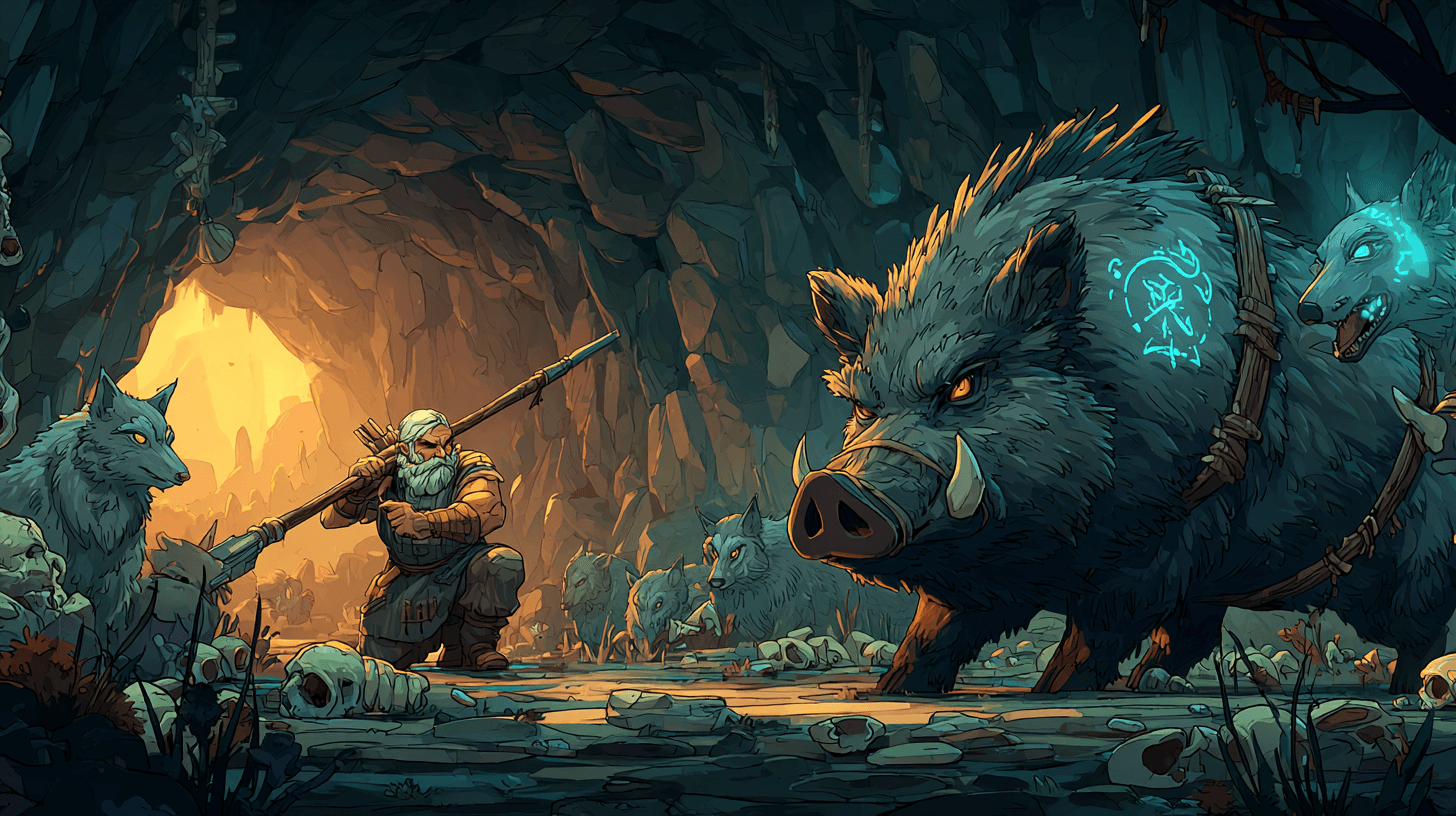
The tunnel turned twice and opened into a chamber — natural, rough-walled, perhaps thirty feet across. The ceiling was low enough that the boar's bristles brushed it. Bones littered the floor: goat bones, sheep bones, the small delicate skeletons of birds and rabbits. A larder. A storehouse of death, neatly organized — older bones pushed to the edges, fresher kills in the center.
Three wolves were waiting.
They'd known we were coming. Of course they had — a dwarf and a pig stumbling through their home with all the stealth of a rockslide. They were positioned at the far side of the chamber, between us and the tunnel that continued deeper, and they were not afraid.
Two were wounded — I could see the cuts from last night, tusk marks and Rensting's clean punctures. The third was fresh. Larger. Not the scarred grey — not the alpha — but big. A guard. It stood with its head low and its pale eyes locked on us, unmoving.
The boar's bristles rose. That rumble in its chest deepened to something I felt more than heard.
The fresh wolf charged.
In the open, it would have been terrifying — two hundred pounds of corrupted predator at full speed. In the cave, it was a mistake. The chamber was wide enough to build speed but the entrance was narrow, and the entrance was full of boar.
The wolf hit the boar like a wave hitting a cliff. The impact was enormous — the boar skidded back six inches on the stone floor, which was the first time I'd seen it give ground to anything — but six inches was all. The boar's tusks caught the wolf in the shoulder, twisted, and the wolf went sideways into the cave wall with a crack that echoed through the chamber. I drove Rensting over the boar's back into the wolf's exposed flank before it could recover.
The rune pulsed. A flicker of cold blue light ran along the spearhead like water on metal. The wolf went still.
The two wounded wolves came at once, converging on the entrance. In the open they'd have flanked us. In here, they had to funnel past the boar, and the boar filled the space like it had been engineered for it. The first hit the boar's right side and clung — teeth in bristle, claws scrabbling — and the boar slammed it into the wall with a lateral shift that would have made a shield-master weep with professional envy. I punched Rensting into the wolf's neck as it hung stunned against the rock. Blue flicker. Down.
The last wolf was smarter. It came low, trying to go under the boar — through the narrow gap between belly and floor, the only space the boar didn't fill. Good plan. Would have worked on a smaller animal, or in a wider passage.
The boar dropped. Just... dropped its full weight. Four hundred pounds, straight down, onto a wolf trying to squeeze through a six-inch gap.
The sound was unpleasant.
I finished it with Rensting because it seemed merciful. The rune glowed steady blue, brighter than before, and in its light the cave walls glistened with moisture and the bones on the floor cast long, strange shadows.
Three wolves. Under a minute. Not because I was skilled — because the cave was the right shape, the boar was the right size, and Rensting was the right weapon. Reach. Precision. Piercing point. A spear in a tunnel is what it was always designed for, even if no dwarf in recorded history has had the tactical humility to admit it.
We pushed deeper.
The alpha was in the next chamber.
I knew before I saw it. The smell changed — thicker, ranker, dominant. The airflow shifted. And the sound: a low, continuous growl that didn't rise or fall but simply existed, like machinery running in a deep place.
The tunnel opened into a smaller space, maybe fifteen feet across. And there it was.
The scarred grey. The pale eyes that had watched me from the tree line, that had assessed my defenses and found the weakness, that had organized nine wolves into a tactical assault on a fortified position. The alpha.
It was larger than I'd realized. At the tree line, in the dark, scale was hard to judge. Here, in the close confines of its own den, it was brutally clear. Shoulder height nearly to my chest. The scar across its muzzle was old and ragged. The teeth that jutted from its jaws were the longest I'd seen — curved, yellowed, cracked, all of them wrong.
Two more wolves flanked it. The last of the pack.
The alpha didn't charge. It studied me. Those pale eyes moved from Rensting's point to the boar in front of me, and I saw something in that look that went beyond animal intelligence. Recognition. It had seen this before — last night, at the farm. The wall and the sting.
It came fast.
Not at me. At the boar. A direct, committed charge at the thing that had blocked its pack all night. A tactical decision. Remove the wall. Then deal with what's behind it.
The boar met it.
The collision was the worst thing I've ever heard. Not the loudest — the Great Forge is louder, and my anvil hitting the Grandmaster's portrait was louder — but the worst. Two massive animals, both committed, in a space too small for either. The boar's tusks scored the alpha's chest. The alpha's jaws found the boar's shoulder — not bristle, not hide, but deep, those impossible teeth sinking into muscle.
The boar screamed. I'd never heard it make that sound. A raw, grinding shriek that bounced off the cave walls and multiplied into something that could have been rage or agony or both.
The boar did not back up.
It drove forward. Into the teeth. Into the pain. It lowered its head and pushed, with everything it had, and the alpha — for the first time — gave ground. One step. Two. Claws scrabbling on stone, trying to find purchase, and the boar kept driving, tusks working in short vicious arcs, each one opening a new line of red across the alpha's body.
The two flanking wolves rushed the entrance. I caught the first with Rensting — a quick thrust that found ribs and punched through — and the second hit the boar's hindquarters and held on. The boar kicked. Not a delicate motion. Four hundred pounds of torque through a hind leg built for rooting through frozen earth. The wolf came free of the boar and hit the ceiling and then the floor in that order, and I put Rensting through it before it could stand.
The alpha was still fighting. Still on its feet, still pushing back against the boar, jaws locked on the boar's shoulder with a grip that was grinding bone. Blood was everywhere — the boar's, the alpha's, mixed and pooling on the stone floor. The boar's legs were shaking. For the first time, I saw the limit of what four hundred pounds of stubborn could endure.
I didn't think. I stepped around the boar — into the gap between its flank and the cave wall, close enough to feel the heat of the fight and smell the copper of blood — and I drove Rensting into the base of the alpha's skull.
Not a thrust. A placement. The five-sided point went in just behind the ear, where the spine meets the brain. The rune blazed blue-white, so bright I could see the bones of my own fingers through my grip, and the alpha went rigid — every muscle locking at once — and then it went limp.
The jaws released. The boar staggered, freed from the weight of those terrible teeth. The alpha slid off Rensting's point and hit the cave floor and didn't move.
The chamber went quiet.
Then the two remaining wolves — the ones I hadn't killed, the ones still breathing at the edges of the den — did something I hadn't expected. Something that made the hair on my arms stand up.
They turned on each other.
Not a dominance fight. Not two wolves competing for the empty position at the top. This was frenzy — mindless, screaming, tearing violence without purpose or direction. They hit each other like they'd been wanting to, like something had been holding them together and it had just snapped and without it they had nothing but rage and confusion and teeth. One tore the other's ear clean off. The other ripped at its companion's flank with a desperation that looked less like aggression and more like panic.
I backed up. The boar backed up. We pressed against the tunnel wall and watched as two wolves that had operated with coordinated, intelligent precision twelve hours ago destroyed each other with the blind frenzy of animals that had suddenly forgotten what they were.
It was over quickly. One died. The other dragged itself to the far wall, bleeding from everywhere, and lay down. Its breathing was ragged. Its eyes — when it looked at me — were different. Not pale. Not that cold, dead luminescence I'd seen in every wolf since the first night. Just... eyes. Brown. Scared. Animal.
It whimpered once. Then it stopped breathing.
I stood in the alpha's den, surrounded by the dead, and realized my hands were shaking. Not from the fight. From what I'd just seen.
Whatever had been driving these wolves — whatever had made them organized and wrong and terrible — had been coming through the alpha. And when the alpha died, it broke. And without it, the wolves weren't monsters. They were just wolves. Confused, terrified wolves that had been something else's puppet for gods knew how long.
The boar's shoulder was bad. The alpha's teeth had gone deep, and the wound bled freely — not spurting, but a steady, persistent flow that darkened the bristles and dripped on stone. The boar stood with its head low, breathing hard, favoring the leg.
"Let me see," I said.
The boar huffed. But it held still while I looked. The wound was ugly but not fatal — the teeth had missed the joint and the major blood vessels. It would need cleaning. Binding. Rest. All things we should go back to the farm for.
I was about to turn around. I was about to say enough and let's go and we won. The alpha was dead. The pack was broken. The farm was safe.
Then I felt the air.
From deeper in the cave. Past the alpha's den. A tunnel continued into the dark, and the air was moving the wrong way — not outward, the way cave air flows when the entrance is below, carrying warmth toward the surface. This air was pulling inward. Down. Like the mountain was breathing in.
I stood very still and let the dwarf in me read the space.
Wrong. Everything was wrong. The airflow said there was a deeper chamber — a large one — but the direction was inverted. Air doesn't pull inward unless something is consuming it, or unless the temperature differential is reversed, or unless the space below is so vast and so cold that it creates its own weather.
None of those options were comforting.
But the tunnel kept going. And a dwarf who stops when a tunnel continues is a dwarf who misses what's at the end. It's bred into us — it's how we find ore, water, ventilation, new chambers. You follow the stone. The stone tells you where to go.
The stone was telling me to go down.