Rensting
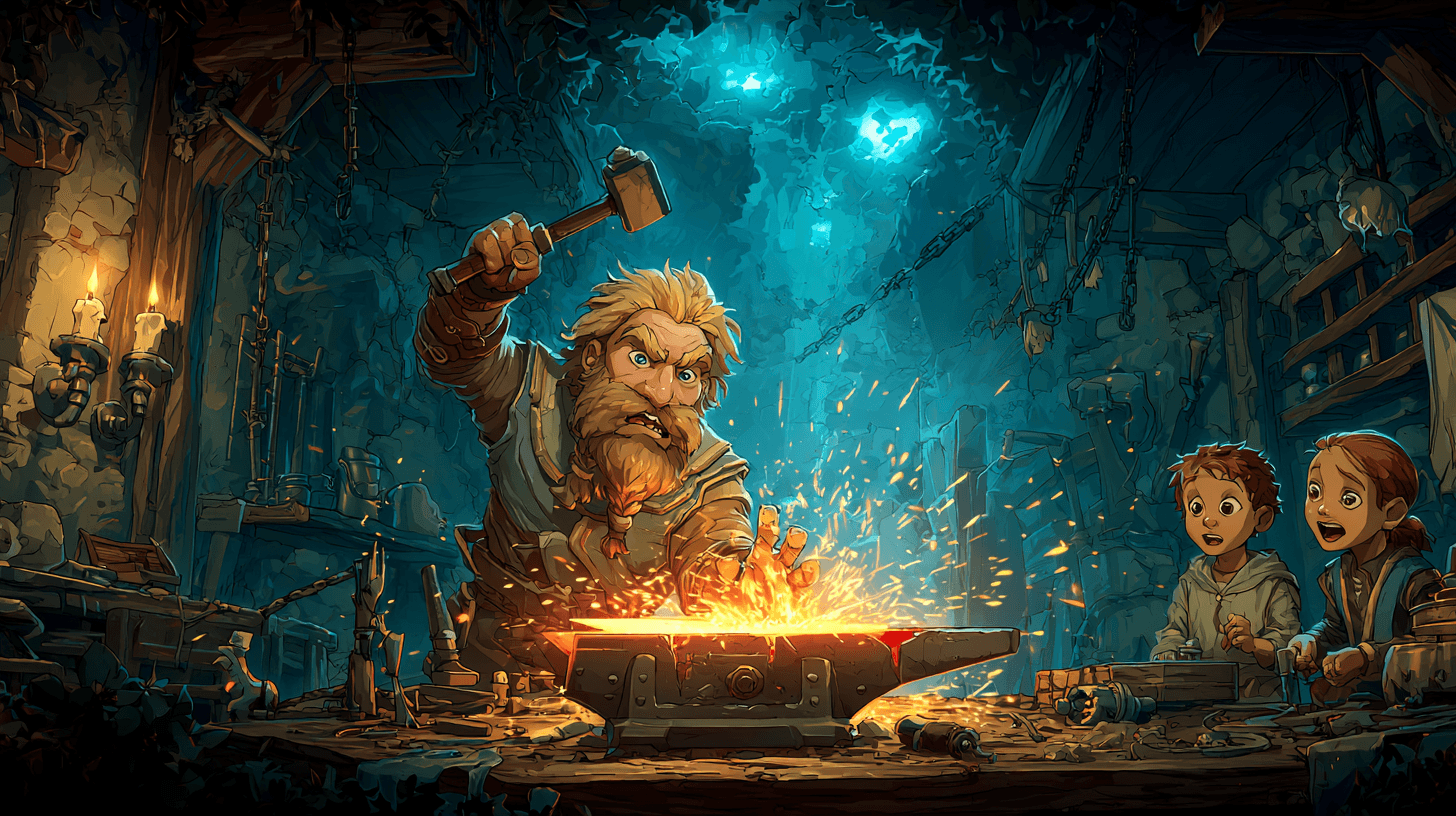
It took me most of the morning to get the forge hot enough.
Charcoal, it turns out, is a deeply unimpressive fuel. I worked the bellows with a steady rhythm — squeeze, release, squeeze, release — and the coals brightened from sullen orange to something approaching usable, but the whole process was like trying to heat a bathtub with a candle. Where a coke-fired blast furnace would have brought iron to white heat in minutes, this pathetic little hearth required hours of patient coaxing. Pump the bellows. Add charcoal. Pump again. Wait. Swear quietly in dwarvish. Pump some more.
Edric watched from a distance for a while, leaning against the barn wall with his arms crossed. I think he was trying to figure out what, exactly, I was doing. When I pulled the first piece of scrap iron from the coals with borrowed tongs and set it on the bread-loaf anvil, he uncrossed his arms. When I began working the metal — folding, striking, folding again to drive out the worst of the slag — he took a step closer.
Let me be clear about what I was making, because it matters later.
A spearhead. Specifically, a five-sided pyramid, tapering to a single sharp point. Not a blade — blades need good steel to hold an edge, and I didn't have good steel. I didn't have any steel. What I had was rough iron full of impurities, and the best thing you can do with rough iron is make a piercing point: a shape where all the force concentrates at the tip and punches through whatever it meets. Five sides, because five gives you the best balance of structural strength and sharpness at the point where the faces converge. It's geometry. Underground, we learn geometry before we learn to read, and for good reason — geometry keeps mines from collapsing. It also, apparently, makes serviceable spearheads.
The first strikes were clumsy. The iron was too cool — I hadn't gotten the forge hot enough — and it fought the hammer like wet clay, sluggish and stubborn. I heated it again. Tried again. Better, but still wrong. The symmetry was off. Two of the five faces were uneven, and the tip was blunt where it should have been sharp. It looked like something a first-year apprentice would produce and then hide under his workbench before the instructor noticed.
I heated it a third time, pumping the bellows until my arms burned and the coals finally, grudgingly, approached a proper working temperature. Pulled the iron. Set it on the anvil. Raised the hammer.
And then something happened.
I don't know how to explain it. I've tried, in the weeks since, to find the right words, and the right words don't exist. The closest I can manage is this: you know the moment just before sleep, when you're not quite awake and not quite gone, and the boundary between thinking and dreaming dissolves into something warm and edgeless? It was like that. Except I was standing up, holding a hammer, and instead of falling asleep I fell into something else entirely.
The strike landed. Not where I'd aimed it — where it needed to go. The difference is crucial. When you aim, you think about angle and force and placement and all the ways you might get it wrong. When the strike lands where it needs to go, you don't think at all. Your arm knows. The metal knows. The hammer falls and the iron answers and you do it again, and again, and the rhythm is so precise, so perfectly even, that it stops feeling like striking and starts feeling like breathing.
My mouth opened, and I sang.
I need to pause here, because sang is both wrong and right. It wasn't singing the way you'd sing a pub ballad or a lullaby. It was chanting — deep, guttural, rhythmic — in a language I recognized as old dwarvish but couldn't, if you'd put a crossbow to my head, have translated a single word of. The syllables came from somewhere below my thoughts. From somewhere below me.
I had heard songs like this before. Once, when I was maybe twelve, I'd snuck down to the observation gallery above the Great Forge — not on a school trip but well past curfew, because I'd followed the sound, the deep pulse that came up through the stone of the lower levels at night — and I'd watched the forge-masters work the late shift. The cavern was dark except for the furnace glow, and in that red light the master smiths sang while they worked. Their voices braided together and fell apart and braided again, following a rhythm that felt older than the words themselves, and even from the gallery, even as a child who understood nothing about smithing or magic or the deep traditions of my own people, I felt it. The way the sound settled into my chest like a second heartbeat. The way the stone beneath my feet hummed in sympathy, as if the mountain itself were listening.
I'd never learned those songs. I wasn't meant to. They were the province of master smiths, passed from teacher to apprentice after decades of training and years of trust. I was a mediocre student who'd been classified as "unremarkable" in red ink, underlined, and assigned to mop tunnels as punishment for destroying a portrait. The forge songs were as far above me as the Grandmaster's office.
But the words were there.
They poured out of me, syllable-perfect, in time with the hammer. I couldn't have stopped them any more than I could have stopped my own heartbeat. The rhythm and the chanting were one thing — the song shaped the strikes, the strikes drove the song — and my hands moved with a precision I had never possessed. Not in thirty years of schooling. Not on my best day, which had produced a rune that Professor Aldrik described as "technically a rune in the same way that a collapsed mine is technically architecture." This was not my best day's precision. This was something else wearing my hands.
Strike. Turn. Strike. Fold. Strike. The iron flattened, bent, thinned. I wasn't thinking about the five-sided pyramid anymore. I wasn't thinking about anything. I was in the metal, feeling the grain of it, sensing the last stubborn pockets of slag like shadows in glass and driving them out with strikes that landed exactly, impossibly right. Each blow rang clean and true, and the sound joined the chanting until the two were indistinguishable — voice and hammer, song and steel, all of it one continuous thing pouring through me like water through a channel.
Mila found me first.
I didn't notice her — I wasn't noticing anything at that point, being somewhat occupied by whatever was happening to me — but I'm told she came out of the farmhouse because she heard the sound. Not the hammering; they'd been hearing that all morning. The singing. The deep rhythmic chant that had no business coming out of a farmyard forge or, for that matter, out of me.
She stood at the edge of the forge area with her mouth open. Just... open. Mila, who had never once in the time I'd known her been at a loss for words, who had opinions about everything and the volume to share them, had no words.
Ren came next. Then Halla, in the doorway of the farmhouse, one hand pressed against the frame as if the ground were moving and she needed to hold on to something. Then Edric, who stopped beside his wife and stared at me with an expression I couldn't have read even if I'd been in any condition to try.
The sound resonated. Not just in the air — in the stone of the forge hearth, in the packed earth beneath my feet, in the bones of the people standing there watching. Halla told me later, through Mila's halting translation, that she felt it in her teeth. Edric, who is not a man given to poetic description, said it was like standing near a river and feeling the current through the bank. Like something powerful was moving, very close, just out of sight.
Even the boar came. It walked across the yard — closer to the family than it had ever been, close enough that Ren could have reached out and touched it — and stopped five paces from the forge. Its broad head was low, its small ears pitched forward, facing me. Not watching. Listening.
I don't know how long it lasted. Edric said an hour. Halla said less. Mila said forever, which is probably the most honest answer.
When it broke — when the trance released me, let me go like a fist unclenching — I staggered.
The hammer slipped from my fingers and hit the ground. My hands were shaking. My shirt was soaked through with sweat and my arms ached with a bone-deep exhaustion that suggested they'd been working far harder than any pair of arms should work for however long it had been. The forge fire had burned down to pale ash and fading embers. And on the anvil, still radiating the faintest warmth, sat the spearhead.
I looked at it.
Five faces. Perfectly symmetrical. Five edges converging at a point so sharp it seemed to narrow beyond visibility, as if the tip existed at a scale smaller than the eye could resolve. The surface was smooth, the grain tight and even, and the color was wrong — not the dull grey of worked iron but something darker, denser, with a faint bluish-black tint that caught the light and did something strange with it. This was not steel. You cannot make steel in a charcoal forge with a hand bellows and a pitted anvil and willpower. I knew that. Every metallurgy lesson I'd ever sat through confirmed it.
But it wasn't the rough, grainy iron I'd started with, either. It was something in between. Something that had no right to exist, given the materials and the tools and the smith.
And on one face of the pyramid, near the base where it would seat against the shaft, there was a rune.
I stared at it for a long time.
It was a dwarven rune. That much was clear — the angular strokes, the branching forms, the way it sat in the metal as if it had grown there rather than been cut. I'd seen runes in textbooks. I'd studied them in Advanced Rune Studies with Professor Aldrik, who had spent three semesters teaching us the theory of runic inscription and one disastrous semester letting us attempt it in practice. My best effort, the one I'd been proudest of, had drawn from Professor Aldrik the assessment: "I can see that this is attempting to be a rune."
This rune was not attempting. This rune had arrived. It was clean, precise, cut with the quiet confidence of someone who had been inscribing runes for decades. A runepriest's mark — the kind of work that requires an understanding of resonance, intent, and magical structure that I did not have. Had never had. Could not have acquired between my third hammer strike and now.
I didn't remember carving it.
I stood there, breathing hard, tongs still in my hand, and tried to reconstruct the lost time. The last thing I could recall clearly was starting the third heating. After that — fragments. The rhythm of the hammer. A feeling of warmth that had nothing to do with the forge. Words I couldn't quite hear, like someone speaking in another room. And then this: a spearhead too good for its materials, bearing a rune I didn't make, cooling on an anvil that shouldn't have produced anything more impressive than a horseshoe nail.
"I must have done it without thinking," I said. To no one in particular. "Muscle memory. From Advanced Rune Studies."
This was, I understood even as I said it, a profoundly stupid explanation. My muscle memory from Advanced Rune Studies had produced nothing but what Professor Aldrik diplomatically termed "aggressive scratching." Whatever had carved this rune had not been my muscles, or my memory, or anything else I could claim ownership of.
I decided not to think about it.
The family was still watching. Edric's expression had changed — not to warmth, not to trust, but to something I couldn't quite name. The look you give a door when it opens to a different room than the one you expected. A recalibration. Whatever he'd thought I was — a strange, useless, stray bearded creature his children had adopted — he was revising the assessment.
Mila was the first to move. She walked up to the forge, peered at the cooling spearhead on the anvil, and said, very quietly for the first time since I'd known her: "Vacker."
Pretty.
I fitted the spearhead to the mop handle that afternoon.
It was precise work — and by "precise" I mean I spent an hour with a borrowed knife, carefully shaping the end of the shaft into a tapered socket that would seat the pyramid's base flush and tight. Then leather wrapping, tight and overlapping, cut from an old harness strap that Halla had brought me without being asked — which was the most direct communication she'd offered since the bowl of stew on the fence post. I secured the binding with iron pins: ordinary nails from Edric's scrap pile, hammered through the shaft and bent flat on the far side. Not elegant. But solid.
When it was done, I held it up.
A spear. Seven feet from butt to tip. The shaft — smooth, pale hardwood, worn from months of mopping and walking and fighting and carrying — fit my hands like it had always been waiting for this. The spearhead caught the afternoon light and drank it in, giving back only that faint bluish-black sheen and the clean angular lines of the rune.
I tested the balance. It was good. Better than good — the weight of the head was precisely right for the shaft, which shouldn't have been possible given that I'd eyeballed every measurement while in some kind of fugue state. I shifted my grip, found the center point without thinking. The spear moved when I moved, like it was listening.
I jabbed at a fence post. The five-sided point punched in three inches through seasoned oak, and when I pulled it free the hole was clean-edged and deep.
I tested it again. Same result. The point was phenomenally, unreasonably sharp — sharper than farm iron had any right to be, sharper than anything I'd ever produced in thirty years of smithing lessons at the Academy. Including the time I'd actually tried, which was not often.
Edric was watching from the barn door. When I pulled the spear free from the fence post the second time, he gave a single, slow nod. Then he looked at the damaged section of fence — the one the wolves had torn through three nights ago — and back at me.
I nodded back. Yes. That's what it's for.
Then there was the matter of the name.
I should explain. When a dwarf forges a personal weapon — not a commission, not a training exercise, but a weapon made by your own hand for your own carrying — tradition demands that you name it. It's an old custom, older than the Academy, older than the Rumbling Deeps, possibly older than the mountains themselves. The name is a bond between maker and weapon. A declaration that this thing you've made is yours, and you will carry it into whatever comes, and whatever comes will have to go through both of you.
Naming conventions vary. Some dwarves choose names of power — Grimjaw, Stonecleaver, Thunderfall. Names that sound like what they do, that carry weight and threat and the implicit promise of someone's bad day. Others name for lineage, honoring a parent's weapon or a master's teaching. And a rare few name for truth — for what the weapon actually is, without pretense or polish.
I held my spear — my mop handle with a point, my desperately improvised un-dwarven abomination that had somehow, through a process I did not understand and could not replicate, become something more than the sum of its terrible parts — and I thought about names.
Not Thunderfall. Not Stonecleaver. Those were names for weapons forged in the Great Forge from deep iron by masters who'd earned the right to be grandiose. This weapon was made from scrap iron on a farm anvil by a student who'd been expelled from crossbow training. It deserved honesty.
I thought about where it came from. A mop handle. Issued for punishment. Used to clean the tunnels of the Rumbling Deeps, to scrub grime and filth from stone floors that no one cared about in passages no one visited. It had been dragged through refuse, soaked in dirty water, propped in corners. Then it had crossed a portal, fought a boar, walked a hundred miles of open grassland, and arrived here — at a farm at the edge of nowhere, in the hands of a dwarf who had no business making weapons, bearing a spearhead that had no business being as good as it was.
And I thought about what had just happened. The trance. The impossibly clean strikes — every one landing exactly where it needed to, not where I aimed it. Clean. The word kept circling back. Ren. Clean. What the mop had done. What the hammer had done. What the point would do.
"Rensting," I said.
Clean-Sting.
It was not a name of power. No forge-master in the history of the Rumbling Deeps had ever named a weapon Clean-Sting. It didn't thunder. It didn't promise devastation. Duggan would have squinted at it, turned it over in his head, and said "that's... not terrible, actually," which from Duggan was practically a standing ovation. The Grandmaster would have been briefly confused, which was better than disappointed.
But it was true. Ren — the cleaning, the years of scrubbing, and the strikes that had come from somewhere else and landed clean as prayer. Sting — because that's what I was. Not a thunderbolt. Not an avalanche. A sting. Small, precise, and enough to make something much larger than me think twice. And the rune on the spearhead — the one I hadn't carved, the one that looked like the work of a runepriest who'd been doing this for fifty years — seemed to approve. Or at least it didn't crumble away in protest, which I was choosing to interpret as endorsement.
"Rensting," I said again, quieter. Testing it. Feeling the weight of the syllables.
And the name settled into the weapon like a key into a lock — like the last piece of something finding its place — and the thing that had been a mop handle and then a walking stick and then a spear shaft became, finally, itself.
I leaned Rensting against the barn wall. The last light of the afternoon caught the rune, and for just a moment — a heartbeat, no more — I thought I saw it pulse. A faint flicker of something that was not reflected light and not a trick of the eye and not anything I could explain. A glow, cold and brief, from inside the metal itself.
Then it was gone, and the rune was just a rune, and the spear was just a spear, and I was very, very tired.
The trance — whatever it had been — had taken something out of me. I could feel the emptiness in my arms, in my chest, in the back of my skull where a headache was quietly establishing a permanent settlement. I sat down against the barn wall, next to my spear, and closed my eyes.
Tomorrow, or the night after, or the one after that, the wolves would come again. They always did. And when they came, I would be standing in a farmyard with a weapon no self-respecting dwarf would carry, bearing a rune I couldn't explain and forged by a song I couldn't remember.
But Rensting was sharp. And balanced. And mine.
And I was ready. Or as ready as I was ever going to be — which, if my life so far was any indication, would have to be enough.