Pale Eyes
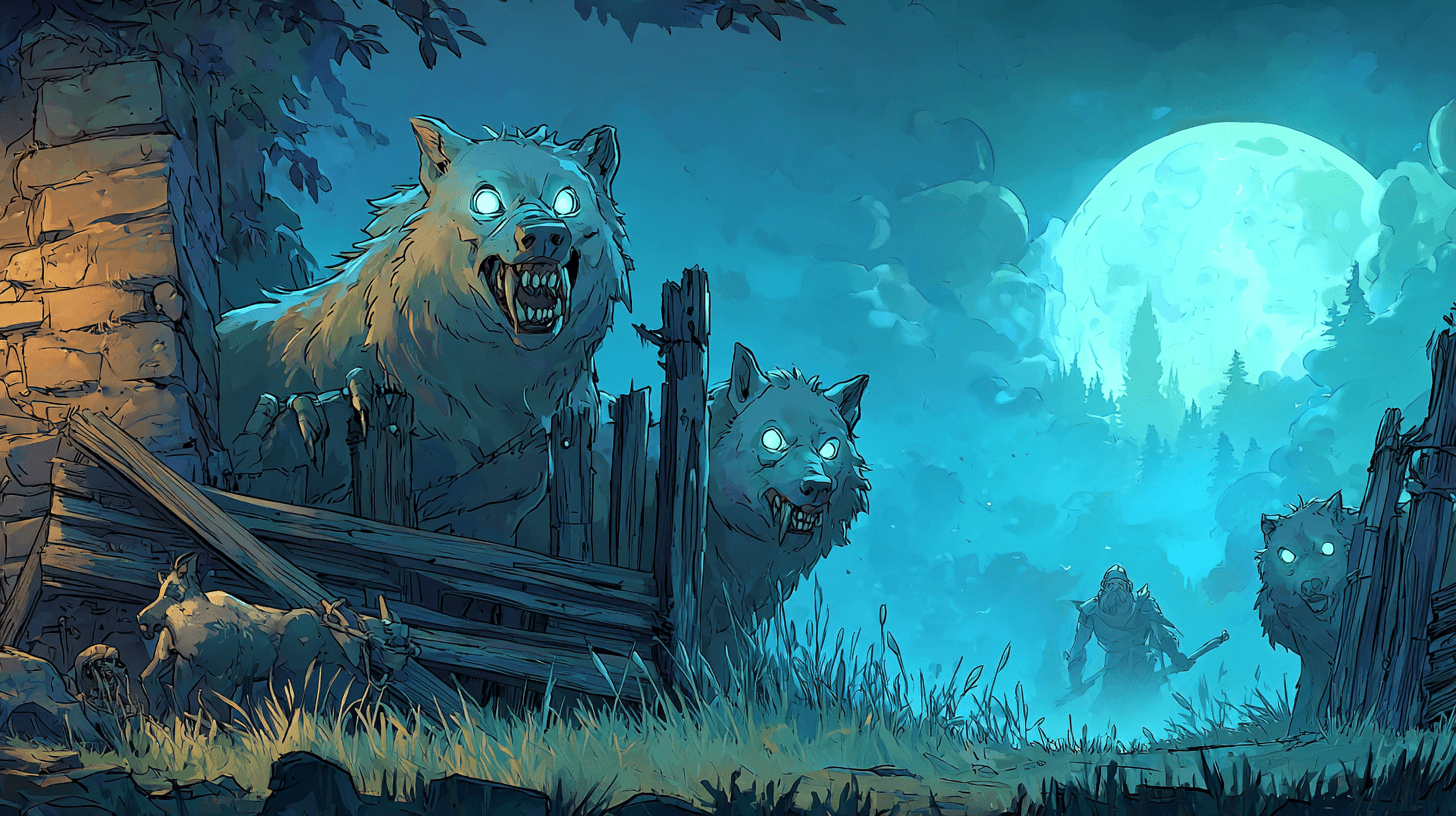
They came on the seventh night.
I know it was the seventh because I'd been counting — a habit I'd picked up from Ren, who scratched a mark into the barn wall each morning with the focused seriousness of a boy who understood that keeping track of things was important, even if he couldn't quite explain why. Seven marks. Seven days since I'd followed chimney smoke to a farmstead and discovered that human children are effective, if occasionally violent, language tutors.
Seven days. In that time I'd learned roughly a hundred and forty words, repaired six fence posts, failed to milk a goat on three separate occasions, and developed a relationship with the chickens that could best be described as a mutual territorial dispute. I was, by my own cautious estimation, becoming almost useful.
Then the screaming started.
Not human screaming — that came later, muffled and sharp from inside the farmhouse. This was something else. A high, bleating shriek from the livestock yard, the sound of an animal in absolute terror, and under it a noise I'd never heard before: a wet, crunching snarl that resonated in my chest like a drum hit wrong.
I was off the straw pile before I was properly awake, mop handle in hand, heart running ahead of my body. I hit the barn door at full speed — which, for a dwarf of my dimensions, is not particularly fast but makes up in determination what it lacks in grace — and stumbled into the yard.
Moonlight. The farm was drenched in it, every surface pale and sharp-edged, the shadows black as mine-water. The goat pen was twenty paces ahead. The fence — my fence, the section I'd reinforced with such dwarven pride five days ago — was intact. But the north side, the original planking I hadn't gotten to yet, was broken. Not rotted through. Punched through. Boards hanging inward like snapped ribs, the wood around the gaps splintered and fresh.
And in the gap, shapes.
Three of them. Low and heavy and moving with a deliberateness that didn't belong to any animal I had ever encountered — not cave rats, not tunnel cats, not the bad-tempered badger that had once taken up residence in Professor Grumthar's office and refused to leave for six weeks. These moved like they were thinking about it.
The closest one had a goat. I could see it — Patches, the one with the brown ear that Mila had named, struggling and kicking in its jaws — and the wolf wasn't finishing the kill. It was dragging. Methodical. Patient. Like a worker hauling cargo.
I stood there.
Not frozen — I want to be precise about this. My legs worked. My arms worked. My brain was working very, very quickly, presenting me with a detailed tactical analysis, which was as follows: three wolves, each roughly the size of a large pony, with jaws capable of punching through oak fencing, versus one dwarf with a broken mop handle and no armor. The analysis was thorough, it was accurate, and its recommendation was: no.
Then the second wolf turned its head and looked at me.
I have spent a lot of time since then trying to describe those eyes. Words fail — not metaphorically, but literally. The words I have are inadequate for what I saw in the moonlight of that farmyard, fifteen paces from something that was looking at me and deciding I didn't matter.
They were pale. Not the reflective shine you see in animals' eyes at night — I'd read about that, the tapetum lucidum, the way certain creatures' eyes catch light and throw it back. These eyes weren't catching anything. They were generating. A cold, flat luminescence, the color of old bone, that seemed to come from somewhere behind the eyes rather than in them. Like lamps behind curtains of skin.
The teeth were worse.
They jutted from the wolf's muzzle at wrong angles — too long, too many, crowding the jaw in a way that shouldn't have been possible for anything that needed to close its mouth. Some extended past the lower lip, visible even when the jaw was shut.
The wolf looked at me. I looked at it. It held my gaze for perhaps three heartbeats — long enough for me to understand, with a clarity that settled into my bones like cold water, that my broken mop handle was a joke. That I was a joke. That this creature did not consider me a threat, or an obstacle, or anything at all worth adjusting its plans for.
Then it turned back to watch its companion drag the goat through the gap in the fence.
The farmhouse door crashed open. Edric came out at a run, barefoot, axe in both hands, shouting something raw and desperate. Halla was behind him in the doorway, the children pressed against her legs, and even in the moonlight I could see that every face wore the same expression: not surprise. Not shock. Resignation. This had happened before. This was happening again.
Edric charged the fence. He swung the axe at the nearest wolf — a good swing, heavy and committed, the kind of swing that would have split a log clean — and the wolf sidestepped it. Not bolted. Not flinched. Sidestepped, with the calm precision of something that understood the arc of an axe and had decided, without apparent concern, to not be where it landed.
The third wolf — the one that had been watching the tree line behind its companions — turned its pale eyes on Edric. I saw something in that look that made my stomach drop. Not hunger. Not fury. Assessment. It was measuring him. Calculating whether he was worth the effort.
It decided he wasn't. The wolf with the goat vanished through the gap. The other two followed — not running, not fleeing. Walking. Retreating on their own terms, at their own pace, into the shadows at the edge of the woods.
Patches had stopped screaming.
The silence after was the worst part. Edric stood at the broken fence with his axe hanging at his side, breathing hard, staring into the dark where the wolves had gone. Halla had gathered the children inside — I could hear Mila crying, a raw, hitching sound that was more furious than frightened, and Ren was silent, which was worse.
Two goats left. There had been three when I arrived.
I walked to the fence. The broken boards lay scattered in the moonlight, and I could see the claw marks where they'd been torn through — fresh grooves in the wood, deep enough to swallow my fingers past the first knuckle. I knelt and studied the tracks in the soft earth on the other side. They were enormous. Larger than my spread hand. The pads had pressed deep, the claw marks extending well beyond the toes, and the stride between them was longer than it should have been. Too long. As if the legs that made them were stretched.
Edric said something to me. I didn't understand the words, but I didn't need to. It was the voice of a man who had been fighting something he couldn't beat for a long time and was running out of ways to pretend otherwise.
I looked at my mop handle.
Edric looked at my mop handle.
Neither of us spoke, because what was there to say? We both knew what it was. A stick. A cleaning implement carried by a dwarf who had been assigned to mop tunnels as punishment for a catastrophic anvil-throwing incident, now standing in a farmyard against wolves that sidestepped axes and tore through oak without breaking stride.
I looked past the barn, to where the old forge sat in the moonlight. Cold. Dark. Covered in cobwebs and disuse.
But a forge.
I pointed at it. Then at the broken fence. Then I made a gesture that I hoped conveyed I can make something better than this stick but probably conveyed something closer to I am having a medical event.
Edric looked at the forge. Then at me. Then at the forge again.
He said one word. I didn't know it, but the way he said it — tired, skeptical, and with the faintest edge of well, what have we got to lose — was translation enough.
He went back to the farmhouse. I stood in the yard with my useless stick, looking at the dark between the trees where three shapes with pale eyes had vanished without hurry.
Two goats left. A fence that wouldn't hold. A family that had been dying by inches before I arrived and would keep dying by inches unless something changed.
The boar was standing at the edge of the yard. I hadn't noticed it arrive — it was just there, heavy and dark and solid, facing the tree line with its broad head low and its ears flat. It had been there the whole time, I realized. Through the attack, through the screaming, through the wolves. Not hiding. Watching. The way a soldier watches an enemy position.
"I know," I said to it.
The boar huffed.
"I know," I said again, and went back to the barn, where I did not sleep.