Teeth Marks
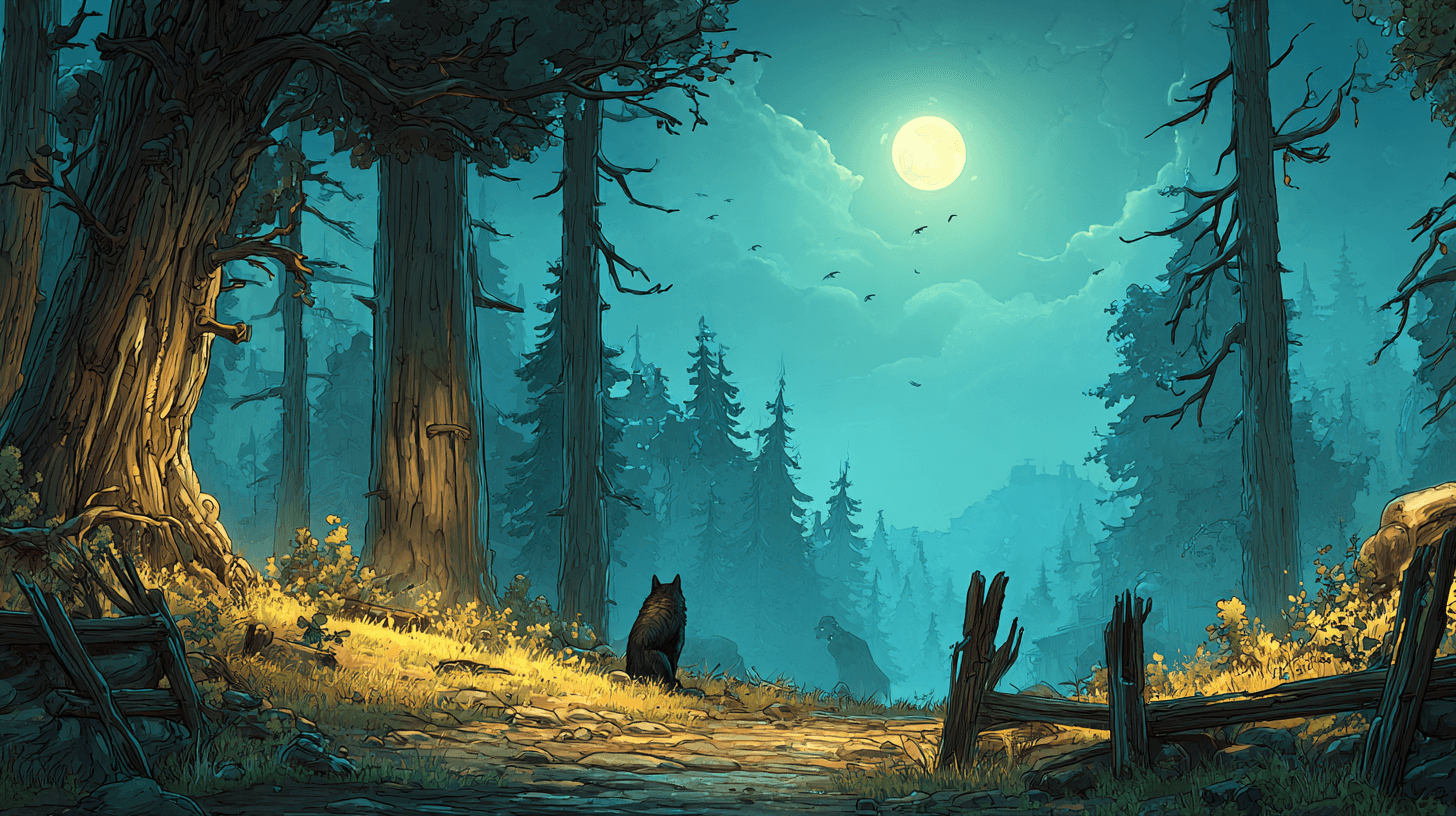
I learned quickly. This surprised no one more than me.
At the Underpeak Academy, I had been a mediocre student in most subjects — decent at smithing, adequate at mineralogy, hopeless at anything involving physical coordination. But reading had always been my trick, the one thing I could do that made other dwarves look at me sideways, and it turned out that the same brain that had devoured eleven library books and a collection of smuggled human texts could also absorb a new language with alarming speed, given the right teachers.
Mila and Ren were the right teachers.
Every morning they found me — by the barn, where I slept on a pile of straw the family had wordlessly provided, or in the yard, where I was attempting to make myself useful — and the lessons resumed. Mila was relentless. She pointed, she named, she corrected, she repeated, she moved on. If I got a word right, she clapped. If I got it wrong, she grabbed my beard and shook it until I tried again. It was, in its own way, more motivating than anything the Academy had ever devised. Ren was quieter, more methodical — he'd mime an action (eating, walking, sleeping) and say the word, then wait patiently for me to connect them. Between the two of them, they were teaching me to speak like a very small, very loud human child, and I was grateful for every bruised syllable.
By the third day, I could ask for water, thank someone for food, and tell the chickens to move — this last one being more useful than you'd expect, because the chickens had decided I was furniture and kept sitting on my boots. By the fifth day, I could form simple sentences. "I am Borin. I am lost. I come from under the mountain."
The children thought "under the mountain" was the funniest thing they'd ever heard. Mila kept asking me to say it again so she could laugh. Ren tried to repeat the dwarvish — Rumbling Deeps — and produced a sound like a badger clearing its throat. Mila didn't even try. She just fell over.
I taught them dwarven words in return. Stein for stone. Djup for deep. Gruvlig for "what in the name of all that is underground." They loved the sounds — all those hard consonants and guttural vowels that humans apparently find charming and dwarves find entirely unremarkable. Language, I was discovering, is less about words and more about willingness. The children were willing. That was enough.
Their father's name was Edric. Their mother's, Halla. I learned these names from the children, not from the parents themselves — Edric and Halla still kept their distance. They let me stay. They fed me. But they watched me the way you watch a stray dog: with sympathy, and caution, and the quiet awareness that something you feed tends to stay.
I tried to earn my keep. I carried water from the well (and spilled most of it, because the buckets were built for human arms and I am not, by any reasonable measure, built for human anything). I tried to milk a goat. The goat had strong opinions about this and expressed them with its hooves. I did not try again.
But then Edric started leaving tools where I could find them — a hammer, nails, a hand saw — the quiet language of a man who couldn't say "thank you" or "you're welcome" but could say here, make yourself useful.
Now. There is a thing you should understand about dwarves and craftsmanship. By the time a dwarf finishes school — which takes roughly thirty years, because dwarven education begins with hitting rocks and only gradually works its way up to hitting rocks precisely — he has spent more time with a hammer in his hand than most humans have spent alive. I am, by dwarven standards, a mediocre smith. I once made a sword that was technically a very aggressive letter opener. My dovetail joints have been described by my instructor as "a crime against geometry." But mediocre by dwarven standards is a distinction worth noting, because dwarven standards involve folding steel eleven times and then complaining that eleven wasn't enough.
Human tools, it turned out, were charmingly simple. The hammer was light and the nails were soft and the saw cut through surface pine like warm butter. I mended the fence post that had been listing since before I arrived. I didn't just prop it up — I reshaped the base, cut a proper tenon, and set it two feet deep with cross-braced supports. When I was finished, you could have tied a horse to it. You could have tied two horses to it. Edric tested it with a shove — then a harder shove — and looked at me differently after that. Not with warmth, exactly. But with the quiet reassessment of a man who has just realized that the stray he's been feeding might actually be useful.
I fixed the chicken coop next. Then the barn door hinge. Then three more fence posts. Each one was solid. Each one was, if I'm being honest, the best piece of woodwork on the entire property, which is either a compliment to me or an insult to the original builder, and I suspect it's both.
It was while fixing the fence on the far side — the damaged section facing the tree line — that I first looked closely at what had broken it.
The torn section on the far side. Three boards ripped outward, facing the tree line. I'd noticed it on my first evening, but I hadn't examined it. Now, kneeling beside it with a hammer in my hand, I could see the marks.
Claw marks. Four parallel grooves, dug deep into the wood. The cuts were clean and even, deeper than any animal I'd encountered underground — cave rats, tunnel spiders, the occasional lost badger — could have made. And they were wide. Very wide. Whatever had done this had paws the size of my hand, with claws that went through three-inch oak planking like it was wet clay.
I pressed my fingers into the grooves. They went deep enough that my fingertips disappeared.
"Varg," said a voice behind me.
I turned. Ren was standing there, looking at the claw marks. His face had none of the easy humor from our language lessons. He looked older, suddenly. More like his father.
"Varg," he repeated, and mimed something — four legs, a long snout, teeth. He made a howling sound, soft and eerie, that raised the hair on my arms. Then he pointed at the claw marks and held up three fingers.
Three of them.
"Varg," I said. The word sat heavy in my mouth.
Ren nodded. He pointed toward the livestock yard, where the goats clustered together in the center despite the afternoon sun, then held up one hand showing five fingers and slowly closed two of them. Five once. Three now. He pointed at the tree line and drew a finger across his throat.
His hand was shaking. Just slightly. But I noticed.
That evening, Mila tried to tell me a story.
We were sitting by the barn, the last of the daylight turning the fields gold, and she launched into it the way she launched into everything — full speed, no warning, absolute confidence that I would keep up. I didn't keep up. My vocabulary was maybe sixty words by then, and Mila was using at least two hundred, plus sound effects.
But I caught pieces.
Varg. She said it several times, making herself big, baring her teeth. Stor varg. Big wolves. She held her hand above her head — taller than her, which was alarming for a wolf, though I allowed for some dramatic license. Then she made her eyes wide and said something I didn't understand, and when that didn't work she tried again, slower: the varg came at night. They came to the fence. They took the get — the goats. She mimed something being dragged, screaming. She mimed her father running out with an axe and the wolves not running away. She mimed her mother pulling her brother inside.
Then she said a word I hadn't heard before and touched her own teeth, pulling at them, stretching the gesture out until her fingers were a full hand-span from her mouth. Long teeth. Too long. She shook her head — inte normal, she said. Not normal. Even Mila, seven years old and afraid of precisely nothing, looked uncomfortable saying it.
Ögon, she said. Eyes. She pointed at her own, then made a gesture outward — something shining, something pale. The wolves' eyes glowed. Or were the wrong color. Or both. I couldn't tell. She said the word again, ögon, and shivered.
I sat with that for a while after she went inside. I didn't understand most of what she'd told me. But I understood enough. I understood stor varg and inte normal and the way a seven-year-old shivered when she described eyes that glowed in the dark. And I understood the claw marks in the fence that went through three inches of oak. Whatever was in those woods, it was wrong. Not surface-world-is-different wrong. Wrong in a way that even a child could feel.
And then, that night, I heard them.
I was lying on my back, staring at the barn ceiling — wood, not stone, but close enough to be comforting — when the first howl came. Distant but clear, rising from the dark tree line to the north. A second voice joined it. Then a third.
There is a quality to a wolf's howl that I cannot adequately describe. It is not like any sound underground — not the groaning of deep rock, not the skittering of cave spiders, not even the roar of the Great Bellows. It is hollow. It is patient. It is the sound of something that has all the time in the world and knows exactly where you are.
Through the barn wall, I heard the farmhouse door rattle — someone checking the bars. A child's voice, quickly hushed. Mila or Ren, frightened, silenced. Then nothing. The whole farm held its breath.
The howling lasted perhaps a minute. Then it stopped, and the silence that followed was worse.
I lay there in the dark, listening to my own heartbeat. I thought about the claw marks in the fence. Mila's story — stor varg, inte normal, teeth too long, eyes that glowed. The goats that used to number five. The way Edric checked the tree line every time he stepped outside, axe in hand, as if expecting to see something step out of the shadows. The way Halla kept the children within arm's reach after dark. The way Ren had looked at me when he said varg — not with fear, exactly, but with the tired resignation of a boy who has been afraid for so long it has become ordinary.
These people had taken me in. They couldn't understand me and I couldn't understand them and they had fed me and sheltered me and let their children teach me their language while something in the woods circled their home at night with teeth that could shred oak.
I gripped my broken mop handle. Half a weapon. A joke, really.
But it was what I had.
From outside the barn, in the dark, the boar huffed quietly. I could picture it out there — broad head up, small ears forward, facing the tree line. Awake. It had been sleeping closer to the barn each night, I'd noticed. Close enough now that I could hear it breathing through the wall.
"Varg," I whispered to the ceiling.
The ceiling offered no advice. It was, after all, just a ceiling — though I found its presence more comforting than I could say. Finally, after days of nothing but sky, something solid above my head.
I closed my eyes. I didn't sleep for a long time.
But somewhere between the silence and the dawn, I decided — with the particular certainty of someone who has absolutely no idea what he's doing — that I was going to do something about those wolves.
I didn't know what yet. I had a stick, a book on portal theory, and approximately forty words of a language I'd been speaking for less than a week.
But Edric had a forge. I'd seen it behind the barn — cold and unused, covered in cobwebs, but a forge nonetheless. And I might be a mediocre smith by dwarven standards, but dwarven standards involve folding steel eleven times and then complaining that eleven wasn't enough.
I could make something better than a stick.
I was going to need it.