Iron and Shame
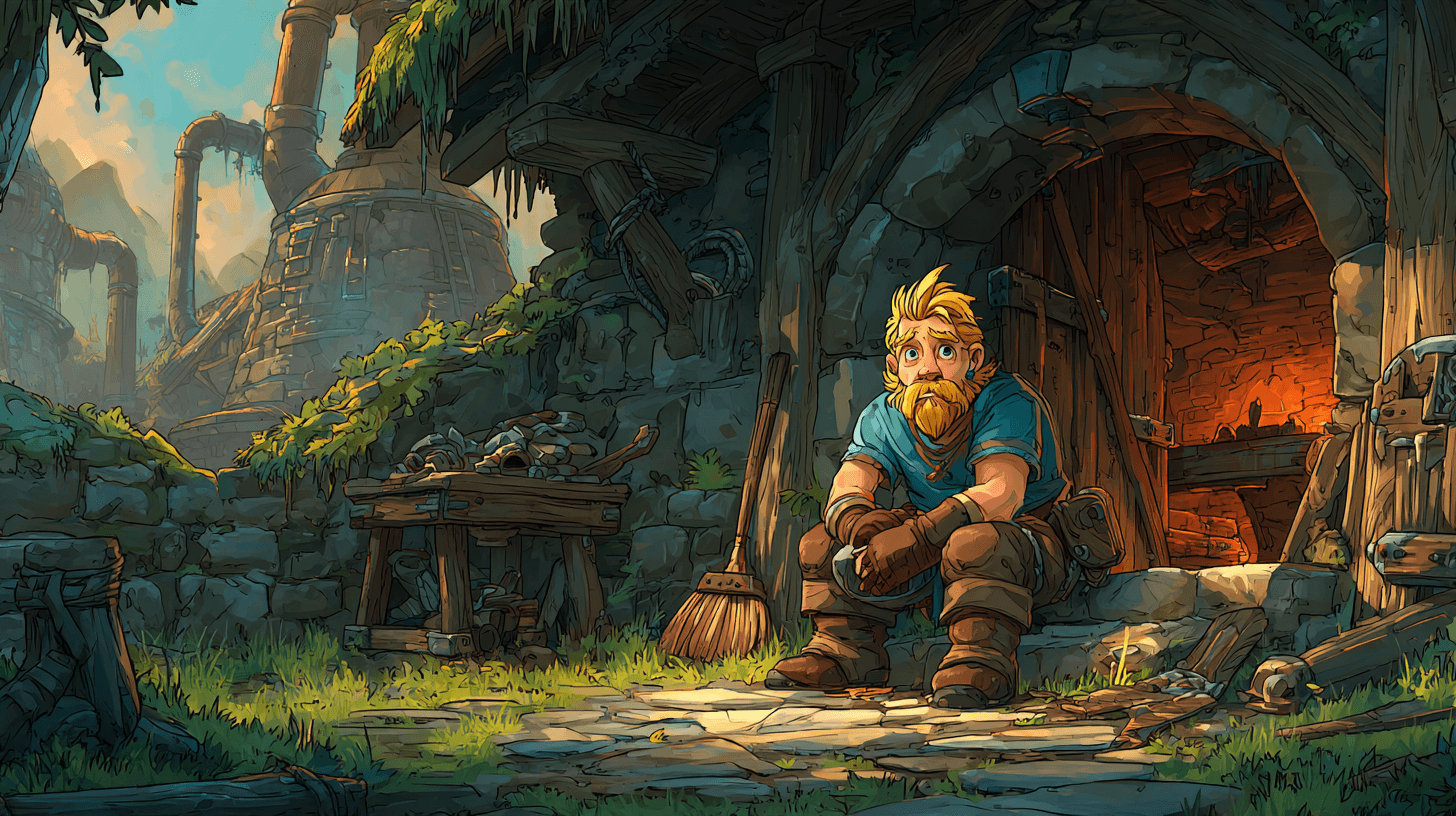
I should tell you about the Great Forge.
Not because it's relevant to the immediate problem of being stranded on a farm with two remaining goats and three wolves — or rather, two goats because of three wolves — but because you need to understand what a dwarven forge is supposed to look like in order to fully appreciate what Edric's forge looked like. Context matters. Especially when the context makes you want to cry.
The Great Forge of the Rumbling Deeps sits at the lowest inhabited level of the fortress-city, carved into a natural cavern so vast that the ceiling disappears into darkness. Underground rivers — three of them, diverted through centuries of engineering that would make human architects weep with inadequacy — feed a system of stone aqueducts that power the bellows, the hammer mills, and the cooling channels. The bellows alone are the size of houses, made from troll-hide leather stretched over iron frames, and when they breathe, the whole mountain trembles. You can feel the Great Forge from six levels up. You can hear it from eight. It has a pulse, like a heartbeat, and after a while you stop noticing it the same way you stop noticing your own.
Then there are the blast furnaces. Fed by coked coal — raw coal baked in sealed ovens until it burns hotter and cleaner than anything the surface world can produce — they reach temperatures that would kill an unprotected human in minutes. Dwarven smiths work in that heat like it's a warm bath. I've been to the observation gallery on school trips — every student goes at least once, to watch the forge-masters work and to learn what a proper dwarf looks like with a hammer in his hand. The air shimmers. The metal glows white. And the sound — the rhythmic, chest-deep boom of hammer on anvil, dozens of them at once, echoing off the cavern walls until the whole world pulses with it — is something you feel in your bones long after you leave.
Steel is the baseline. Common steel, the kind that most human smiths have never produced and wouldn't know how to begin producing, is what dwarven apprentices practice on before they're trusted with real work. It's made through a process of repeated smelting, carbon control, and folding that requires furnace temperatures only coke-fired blast furnaces can reach. Above common steel sits deep iron ore — mined from the lowest veins, where the rock is dense and old and has had millennia to compress — which makes a superior alloy that holds an edge like it has a personal grudge against bluntness. Above that, meteor iron: fallen from the sky, impossibly rare, prized for properties that metallurgists argue about and rune smiths refuse to explain. Used only for masterwork pieces and ceremonial weapons. And above all of it, at the very peak, materials with inherent magical properties — metals that sing under the touch of rune smiths, that hold enchantments the way stone holds heat, that are worth more than entire mining operations and are handled with the reverence usually reserved for holy relics.
The Great Forge employs hundreds of smiths, organized into tiers of specialization, with apprenticeships that last decades and mastery that takes a lifetime. The best of them — the forge-masters — are revered like artists and feared like generals, because a dwarf who can shape metal is a dwarf who shapes the world.
I stood in front of Edric's forge and tried very hard not to weep.
It was a stone hearth. About three feet wide. Open-topped, with no chimney to speak of — just a rough gap in the overhang where smoke could theoretically escape if it felt motivated. A hand bellows made of cracked leather that wheezed when I tested it, producing a sound like an elderly goat with respiratory problems. A pitted iron anvil roughly the size and shape of a bread loaf, which had clearly spent most of its useful life as a doorstop. A water trough for quenching that currently housed a thriving community of spiders, who seemed offended by my intrusion.
There was no aqueduct. No blast furnace. No coke. Just charcoal — a small, lumpy pile of it, uneven and full of bark fragments, the kind made by burning wood in a pit and hoping for the best.
The iron available was a collection of scrap pieces that Edric kept in a wooden crate near the barn: old nails, bent and rusty. A broken hinge. The remains of what might once have been a plowshare, or possibly a very large spatula. I picked up a piece and turned it in my hands. Grainy. Uneven. Full of slag inclusions that would make it brittle if not carefully worked out. Back home, this would have been recycled — melted down and re-smelted with proper flux until the impurities burned away. Here, with a hand bellows and charcoal, I'd be lucky to get it workable at all.
But.
But.
Here is the thing about dwarven smithing that humans don't understand, because humans haven't spent thirty years learning it: the equipment matters, but the hands matter more. A master smith can produce acceptable work on a bad anvil. A skilled smith can coax decent metal from poor ore. Even a mediocre smith — and I am, I want to be absolutely clear about this, squarely and comfortably in the mediocre category — knows techniques that compensate for inferior tools. Fold the metal more. Work it longer. Control the temperature with bellows rhythm instead of furnace settings. It won't be dwarven quality. It won't be steel. But it will be something, and something was better than a stick.
The question was: something what?
This is where I need to tell you about dwarven warfare, and about me, and about why the two have never gotten along.
Dwarves fight heavy. It's not a preference — it's a doctrine, bred into us by thousands of years of underground combat where tunnels are narrow and formation fighting is everything. A dwarven shield wall — heavy plate armor, tower shields, polearms or war axes — is one of the most feared formations in the known world. There are songs about it. Ballads. The kind where every verse ends with something getting crushed and the chorus is just the sound of metal hitting metal.
Behind the shield wall come the war hammers and battle axes. Weapons designed to crack armor, break stone, and end arguments with geological finality. A standard dwarven war axe weighs more than most humans can comfortably lift with both hands. That is not an exaggeration. I've seen human merchants at trade fairs try to hoist one for a laugh. They don't laugh for long.
And for dwarves who lack the physique for the front line — because not every dwarf is built like a walking fortress, much as dwarven culture pretends otherwise — there's the crossbow. Dwarven crossbows are mechanical marvels: heavy draw weight, precision windlass mechanisms, and a range that makes them devastating at distances where human archers are still fumbling with their second arrow. You don't need to be strong to fire one. You need steady hands, patience, and the willingness to stand behind bigger dwarves and wait for the order to shoot.
That was supposed to be me. Crossbow corps. The dignified option for dwarves who were too small for the hammer and too clever to waste. My arms instructor, Hammerhand Krag, had tried. I want to be fair to the man. He had genuinely, patiently tried to teach me the crossbow for an entire semester, and for the first two weeks he'd been almost optimistic. "Steady hands," he'd said, watching me load the windlass mechanism without pinching anything important. "Good eye. This might actually work."
It did not work.
The bolts went everywhere — and I mean everywhere — except where I aimed them. Left when I aimed right. High when I aimed low. On one memorable occasion, directly backward, which Hammerhand Krag said he'd never seen before and hoped never to see again. He adjusted my stance. He adjusted my grip. He stood behind me and physically aimed the crossbow himself, and the bolt still veered wide, as if the universe was course-correcting against any attempt to make me accurate. By the end of the semester, Krag had developed a specific facial expression — a kind of controlled blankness, like a man watching his house burn down for the second time — that he wore exclusively during my training sessions.
Then came the Ironarm Tournament. The anvil toss. The moment that confirmed, beyond any remaining doubt, that my relationship with projectiles was not merely adversarial but ideological.
Hammerhand Krag had watched from the stands. He did not speak to me afterward. He simply removed my name from the crossbow training roster and replaced it with the word no, underlined twice, in red ink.
So. Not heavy weapons — I lacked the build. Not ranged weapons — the universe itself had vetoed that option with extreme prejudice. What, exactly, was left?
I sat on a stump behind the barn, turning a piece of scrap iron in my hands, and thought about it. The morning sun was warm on my face. Somewhere behind me, Mila was trying to teach the boar to sit, a project that was going about as well as you'd expect. I could hear her giving commands in an increasingly stern voice and the boar ignoring them with what I imagined was a profoundly indifferent expression.
The answer, when it came, was so obvious and so deeply humiliating that I spent a full five minutes trying to think of literally anything else.
A spear.
A spear.
Not a war axe. Not a hammer. Not a crossbow. Not even a sword, which dwarves consider a long knife for people who can't commit to a real weapon. A spear. The weapon of reach. The weapon of keeping something at arm's length and hoping it doesn't close the gap. The weapon of farmers and militia and frightened people who've been given a stick with a point and told to hold the line.
The least dwarven weapon in existence.
I could hear Duggan's voice in my head, clear as if he were sitting beside me on that stump. "A spear, Borin? You're going to make a spear? Why not just sharpen a log? Why not tie a knife to a broom? At least then you'd be staying true to your roots as a cleaning professional."
I could picture the Grandmaster's face. The slow headshake. The disappointed sigh that communicated, without words, and yet you find new ways to underwhelm me.
A dwarf with a pointy stick. That was what I'd become, here at the edge of the world, in a farmyard with two goats and a forge that wouldn't pass inspection as a fire hazard.
But.
The thing about a spear — and I knew this because I'd read everything in the Underpeak library and quite a few things smuggled in from the surface — is that it works. It's the oldest weapon in the world for a reason. Reach keeps you alive against enemies that are faster than you. A piercing point doesn't need a cutting edge, which means it doesn't need good steel. The shaft is wood — cheap, available, replaceable. And you can make an effective spearhead from the worst iron in the world, because all it has to do is concentrate force at a single point and punch through whatever it hits.
No heavy strength required. No aim required. Just a sharp point, a long shaft, and the willingness to plant your feet and not run.
And I already had the shaft.
My mop handle. The one from the Great Crossing — issued by the Underpeak quartermaster for tunnel-scrubbing duty, carried through a portal, swung at a charging boar, used as a walking stick across a hundred miles of grassland, and now leaning against a barn wall in a country I couldn't name, on a continent I couldn't place, waiting patiently to become something it was never meant to be. It was hardwood — the quartermaster didn't believe in skimping on cleaning supplies, which was possibly the only useful thing to come out of the Academy's legendary cheapness — and it was still solid. Scratched, battered, worn smooth where my hands had gripped it through all those miles, but sound.
All it needed was a point.
I looked at the scrap iron. I looked at the mop handle. I looked at Edric's forge, sad and cold and cobwebbed, the sorriest excuse for a smithing operation I had ever seen in my life, including the time Duggan tried to melt a spoon over a candle to win a bet.
"I'm sorry," I said — to no one in particular, or possibly to every dwarven smith who had ever lived, all of whom were surely spinning in their graves at the thought of what I was about to do to their proud tradition. "I am so, so sorry."
Then I rolled up my sleeves and got to work.