First Words
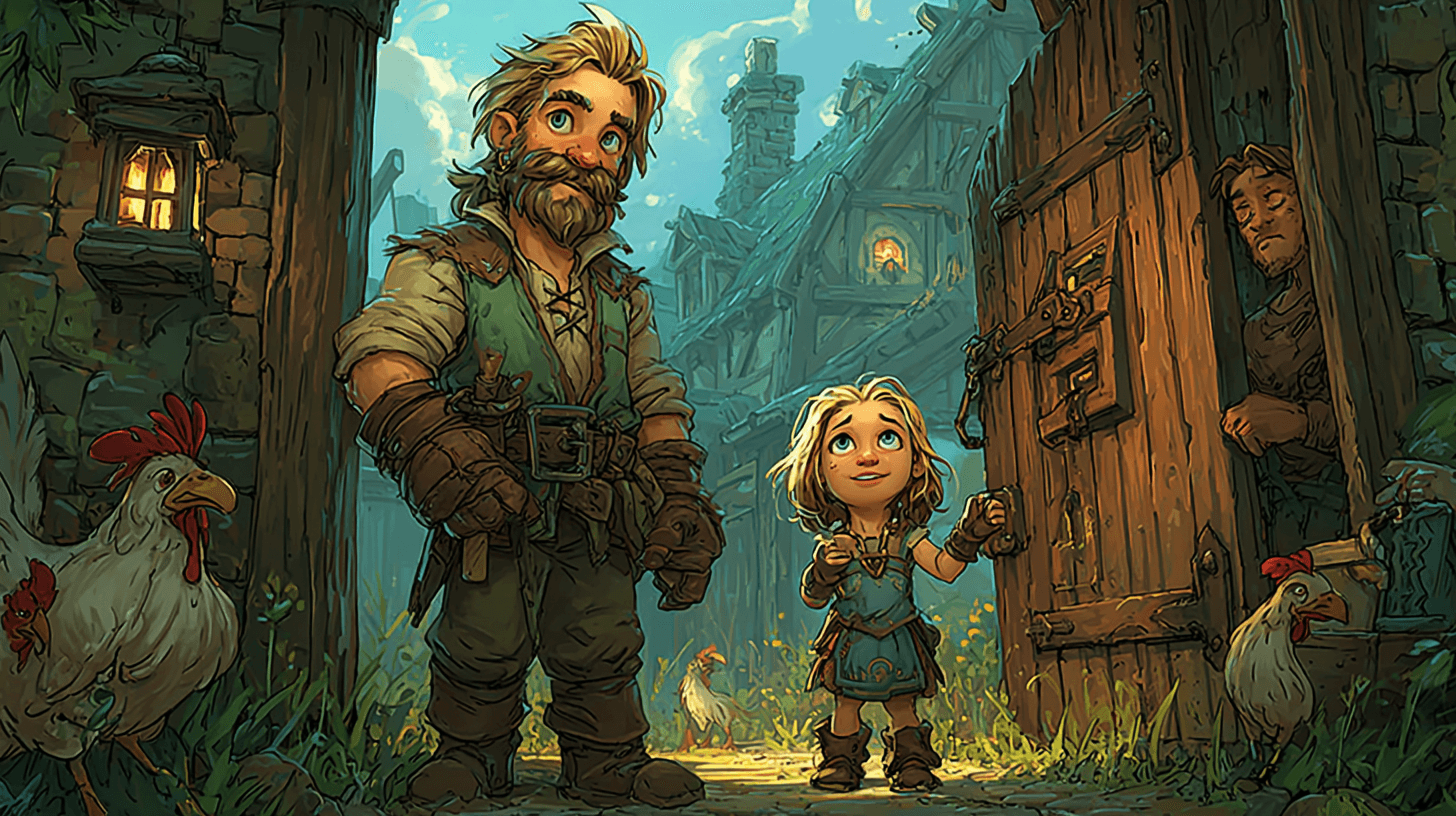
The farm sat in a shallow valley between two gentle hills, like someone had pressed a thumb into the landscape and built a life in the dent. There was a house — wooden, low-roofed, with a chimney trailing the smoke I'd followed. A barn behind it, larger than the house, listing slightly to the left as if it had heard a particularly interesting rumor and was leaning in. A fenced yard. Chickens. A vegetable garden with rows of something green that wasn't grass.
It was, by any reasonable standard, a perfectly ordinary small farm.
But something about it was wrong.
It took me a moment to realize what. The fence around the livestock yard — where a handful of goats huddled close together despite the open space — was reinforced. Not just repaired but reinforced, with extra planks nailed over the originals and sharpened stakes driven into the ground along the base. And on the far side, facing the tree line, three boards were missing entirely. Not rotted through. Torn out. The wood around the gaps was splintered outward, as if something had come through from the other side.
I filed this away in the part of my brain that collects worrying observations, and approached the gate.
"Hello?" I called.
Nothing. Then the farmhouse door opened, and a man came out.
He was tall. All humans are tall to a dwarf, but this one was particularly tall — broad-shouldered, weathered, with hands that looked like they'd spent a lifetime arguing with soil. He wore a rough-spun shirt and trousers, held an axe at his side, and he stared at me the way you'd stare at a talking mushroom.
I understood the stare. I was a dwarf. Three feet and change of blond beard, soot-stained clothing, and broken mop handle, standing at the edge of his farm at dusk. Whatever he'd been expecting when he opened his door, I was not it.
"Hello," I said again, raising my empty hand — the one without the stick. "I'm Borin. I'm lost."
He said something. I have no idea what. The words were shaped differently from any language I'd read or heard — not Old Common, not the Trade Tongue, not even the bastardized human-dwarvish pidgin that merchants use near the mountain passes. This was something else entirely, something local and unfamiliar, and it might as well have been birdsong for all the meaning I could extract.
"I don't understand," I said, which was unhelpful, because he didn't understand that either.
He called over his shoulder. A woman appeared — shorter than him, dark-haired, with the kind of expression that suggested she'd been preparing for exactly this kind of problem, just not this specific version of it. She looked at me. She looked at her husband. She said something sharp and fast, the kind of sentence that, in any language, translates roughly to what is that and why is it on our property?
I pointed at myself. "Borin." I pointed at the ground. "Lost." I pointed vaguely toward the horizon. "Very lost."
The man raised his axe slightly. Not threateningly — more like a man reaching for something familiar while his brain tried to catch up with his eyes. The woman put her hand on his arm and said something quiet. He lowered it.
They were afraid. I could see it now — not just of me, though I wasn't helping matters. There was something else in the way they stood, the way their eyes kept flicking toward the tree line behind me, the way the woman positioned herself between the doorway and the yard as if guarding whatever was inside. These were people living with a fear that had been there long before I arrived.
I was about to try another round of useless gesturing when a face appeared behind the woman's hip.
Small. Round. Dark eyes, enormous with curiosity. A child — a girl, maybe seven or eight in human years, peering around her mother at the strange bearded creature standing in her yard. Behind her, slightly taller, a boy. Maybe ten. Same dark eyes, same fascination, but doing a better job of pretending he wasn't interested.
The woman tried to push them back inside. The girl ducked under her arm and walked straight toward me.
Her mother said something — urgent, warning — but the girl ignored it in the way that children everywhere ignore their parents when something more interesting is happening. She stopped about five feet from me and stared.
I stared back.
She was the first human I'd ever been close to. I'd seen human merchants at the Rumbling Deeps trading posts, but always from a distance, always in passing. I'd never been this close. She was small for a human child but still taller than you'd expect next to a dwarf. Bare feet. A smudge of dirt on her cheek. A gap where a front tooth was working on being replaced.
She reached out and grabbed my beard.
I held very still — the way you hold still when a small animal approaches and you don't want to frighten it, except in this case the small animal was a human child and I was the one trying not to be frightened. She tugged experimentally. Harder than you'd think.
"Ow," I said.
She giggled. And kept pulling.
"Ow. That's — that's attached."
She giggled harder. Behind her, the boy had crept closer, drawn in by his sister's boldness. He reached out and poked my arm, then jumped back, as if testing whether I was solid.
I pointed at myself. "Borin," I said.
The girl tried it. "Boh-rin." She looked up at me, checking.
"Close enough."
She pointed at herself. "Mila." Then at her brother. "Ren."
Mila and Ren. I had my first two words of human.
What followed was the most exhausting language lesson of my life, conducted entirely by a seven-year-old with the patience of a saint and the volume of a foghorn. Mila pointed at everything — the house, the sky, the ground, the chickens, her own feet — and said the word. I repeated it. She corrected me. I tried again. She laughed, corrected me again, and moved on to the next thing before I'd properly finished mangling the last.
Hus. House. Vaten. Water. Eta. Eat. Trae. Tree. Barn. Child. Sol. Sun.
Ren joined in more quietly, filling gaps his sister missed, repeating words slowly when I stumbled. Between the two of them, they were a more effective teaching team than any tutor I'd had at the Underpeak Academy, including Professor Grumthar, whose teaching method consisted primarily of throwing chalk at students who answered wrong.
The parents watched from the doorway. They didn't approach, but they didn't chase me off either. I think it was the children's doing — their easy, fearless trust was a kind of permission the adults couldn't quite grant themselves. When Mila dragged me by the hand toward the water trough to teach me vaten, the father actually stepped aside.
They fed me. The mother — I would learn her name was Halla — set a bowl on the fence post nearest to me. Not close, not welcoming, but not hostile either. A carefully calibrated distance. Stew, dark and thick, with root vegetables and something that might have been mutton. I ate it with my fingers and tried to look grateful, which wasn't hard because it was the best thing I'd ever tasted, including Gloria's stolen lunches, and that is not a comparison I make lightly.
Gratitude, I discovered, doesn't need translation. The way you close your eyes on the first bite. The way you scrape the bowl. These things mean the same in any language.
As the light faded, the family's mood shifted. The father — Edric, though I wouldn't learn that for days — walked the perimeter of the yard, checking the reinforced fencing, testing each stake with a tug. The mother called the children inside with a sharpness that hadn't been there before. Mila waved goodbye to me from the doorway, bouncing on her toes. Ren gave me a solemn nod that looked practiced, like he'd been watching his father do it.
Then they barred the door.
I heard the sound clearly in the evening quiet — not one bar but three, slotting into heavy brackets. Wood against wood against wood. The sound of people locking out the dark.
I looked at the torn fence planks. At the goats pressing tight against each other in the reinforced yard. At the tree line, where the last of the daylight was draining away and the shadows were thickening into something solid.
From somewhere behind me, in the darkness beyond the farm, the boar grunted softly. Still there. Still following.
I settled against the barn wall with my broken mop handle across my knees, pulled my shirt tighter against the cooling air, and watched the tree line until the stars came out.
I didn't know the word for afraid yet. But I was learning.