Walking Nowhere
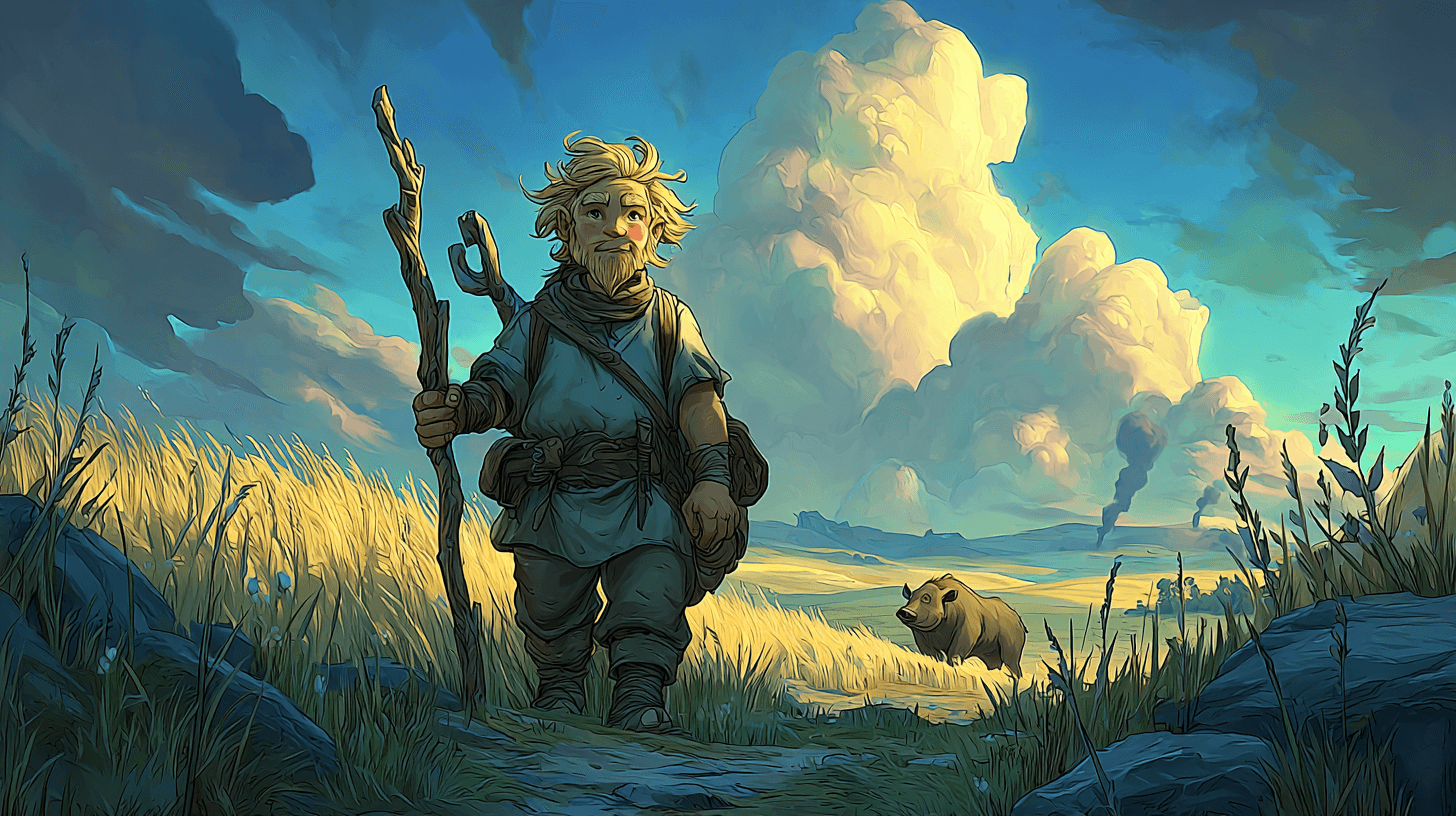
I went back to look for the portal.
I'm not sure what I expected to find — a glowing archway hovering over the hillside, perhaps, with a helpful sign reading This Way Home, Sorry About The Inconvenience. What I found was grass.
I'd spent the night by the fire, the boar snoring somewhere to my left, and when dawn came — which it did with an offensive amount of light and birdsong — I retraced my steps to the spot where I'd landed. I was fairly certain this was the right place. The grass was still flattened where I'd fallen face-first into it. A mop-handle-sized divot marked where I'd dropped my weapon during the boar incident. And there, half-buried in a clump of wildflowers, was Aldara's book.
A Treatise on the Practical Application of Aetherial Conduits. I picked it up, brushed off the dirt, and checked the pages. Still intact — whatever enchantment had preserved it through centuries underground apparently also worked above ground, which was more than I could say for my confidence.
But there was no portal. No arch. No shimmer in the air, no faint hum of aetherial resonance, no crack in the world leading back to the Rumbling Deeps. Just a hillside, some flowers, and a sky that went on forever in every direction.
I sat down and read through the portal chapter again. According to Aldara's notes, a portal required an arch on each end — a sending arch and a receiving arch. The sending arch was in her chamber, two levels below the Great Crossing, behind a wall that everyone had forgotten about. The receiving arch should have been here. Somewhere. An arch of carved stone, roughly ten feet tall, with rune-covered pillars and crystal brackets at the base.
I looked around.
There was no arch.
Which meant one of three things: it had been destroyed, it had been buried, or it had never existed on this end and the portal had simply spat me out like a seed from a grape. None of these options were encouraging.
I waited. I'm not sure how long — a few hours, maybe. I sat on the hillside with the book in my lap and watched the spot where I'd appeared, hoping for some sign: a flicker, a glow, a faint rune-light that would tell me the magic was still working, still connected, still offering a way home.
Nothing. The grass grew. The wind blew. A beetle climbed my boot, assessed my situation with apparent pity, and climbed back down.
"Right," I said. To no one. "Right."
Gloria would have known what to do. Gloria always knew what to do. She would have stood up, brushed off her hands, and said something like "well, sitting here won't fix it, will it?" and then she'd have picked a direction and walked, because Gloria understood something I never have: that doing something stupid is almost always better than doing nothing at all.
I stood up. I brushed off my hands. I said, "Well. Sitting here won't fix it."
It didn't sound as good when I said it.
I tucked the book inside my shirt — it was the only thing I owned that might actually be useful, assuming I ever found another portal, or another mage, or another anything — picked up my broken mop handle, and looked around.
The hillside sloped down in every direction, but the land to the south dipped lower than the rest, and the green was darker, which usually meant water, and water usually meant people. In books, at least. In real life, water might just mean mud, but I was choosing optimism.
I walked south.
The surface world, it turns out, is unreasonably large.
Underground, everything has walls. Tunnels have endpoints. Caverns have boundaries. Even the Grand Crossing, the widest space in the Rumbling Deeps, has a ceiling you can hit with a well-thrown boot. There are limits. The world fits.
Up here, nothing fit. The sky went on until it curved. The grass went on until it became trees. The trees went on until they became more trees. I walked for hours and the horizon stayed exactly where it was, mocking me with its terrible consistency.
I missed ceilings. I missed the comfortable weight of rock above my head. I missed knowing that the world had edges.
I also missed lunch, but that was less philosophical.
The terrain changed as I walked — open grassland gave way to patches of woodland, then back to grassland, then more woodland. I skirted the trees when I could, keeping to open ground. It felt safer, though I'm not sure why. Perhaps because nothing in the open could sneak up on me. Perhaps because the trees reminded me of the stories I'd read about surface forests — stories that usually involved things with teeth.
I had been walking for perhaps three hours when I heard it.
A rustling in the tall grass behind me. Not wind — wind doesn't have weight. This was something heavy, pushing through the stems, and then stopping when I stopped. Starting when I started.
I turned around slowly.
Nothing. Just grass and the gentle slope of the hill I'd come down. Wind moving through the tall stems. A bird wheeling overhead.
I walked on. But I was listening now.
Another hour. Another sound — a snapping branch somewhere to my left. I whipped my head around and caught it: a dark shape at the crest of a low rise, heavy and bristled, silhouetted against the sky for just a moment before it dropped behind the ridge.
The boar.
It was following me.
Not approaching. Not charging. Just... following. Keeping pace from a distance, shadowing me through the grassland like a very large, very hairy escort with an attitude problem.
I stopped and faced the direction I'd last seen it. "I know you're there," I called out.
Silence.
"I can hear you. You're not subtle. You weigh three hundred pounds and you breathe like a bellows with a grudge."
More silence. Then, from behind the ridge, a single, resonant snort.
"I don't know what you want," I said. "I don't have any more rabbit. I don't even have a way to cook rabbit. I have a stick and a book and a very limited understanding of my current situation."
The boar's head appeared over the ridge. It looked at me with those small, dark eyes — not red anymore, I noticed. The fury from our first encounter had gone. What replaced it was something I couldn't quite read. Curiosity, maybe. Or boredom. Or the animal equivalent of well, I've got nothing better to do.
"Fine," I said. "Follow if you want. But I'm not sharing my stick."
I turned and kept walking. Behind me, after a pause, I heard the heavy rustling of something large moving through grass.
We walked like that for the rest of the afternoon. Me in front, the boar perhaps fifty paces behind, the distance between us shrinking so gradually I almost didn't notice. By the time the sun was low and orange, it was close enough that I could hear its breathing — heavy, rhythmic, the kind of breathing that suggests a creature entirely at ease with the world and vaguely put out by the pace.
I talked to it. Not because I expected a response — I'm not that far gone — but because the silence was too big and too empty and too full of sky, and if I didn't fill it with something I was going to start thinking about all the ways this could end badly.
So I told the boar about the Rumbling Deeps. About the way the crystal veins in the deep tunnels catch the lamplight and scatter it into a thousand tiny stars on the ceiling. About the sound of the Great Bellows on forge day, a rhythm so deep you feel it in your teeth. About Duggan, and the time he tried to impress the baker's daughter by eating fourteen rock cakes in one sitting and had to be carried to the infirmary on a stretcher.
I told it about Gloria. About the fourteen copper-red braids and the laugh like gold coins tumbling down a staircase. About the way she stole my lunch without guilt and called me "Bore" and how, even now, standing in a strange land with no idea where I was or how to get home, the thing that hurt most was that I hadn't said goodbye.
The boar didn't respond, on account of being a boar. But it didn't leave, either. And sometimes, on a very bad day, someone not leaving is enough.
The smoke appeared just before sunset.
A thin grey line, rising from beyond a low ridge to the southeast. Not wildfire smoke — too straight, too steady. Chimney smoke. Hearth smoke. The kind of smoke that means someone, somewhere, is cooking dinner.
I stopped. The boar stopped behind me.
"People," I said.
The boar snorted.
"People means food. And directions. And maybe — maybe — someone who knows where I am."
I adjusted the book inside my shirt, gripped my broken mop handle, and walked toward the smoke.
Behind me, the boar followed.