The Ward
I turned to the boar.
"Come on," I said.
The boar did not come on.
It stood at the entrance to the deeper tunnel — the one past the alpha's den, where the air pulled wrong — and it planted its hooves. All four. Locked. Ears flat against its skull, bristles raised in a rigid line along its spine, and its eyes — usually so calm, so magnificently indifferent to everything the world threw at it — were showing white at the edges.
It wouldn't go.
I tried again. Took a step toward the tunnel. Looked back.
The boar looked at me with an expression I had never seen on its face and hoped never to see again. An expression that communicated, with absolute finality: No. There is nothing you can say or do. No.
This was the animal that had charged nine wolves. That had taken the alpha head-on, jaw to shoulder, grinding bone on bone. That had been bitten, clawed, slashed, and beaten, and had not backed up a single step.
And it would not go into that tunnel.
I should have listened to the boar. The boar was smarter than me. The boar had instincts that hadn't been complicated by curiosity, or stubbornness, or the nagging dwarven compulsion to follow a cave to its end.
"Fine," I said. "Stay here. I'll be quick."
The boar huffed. It was not a reassured huff.
I went alone.
The tunnel was different.
Not immediately — for the first thirty paces, it was the same natural stone, the same rough walls and uneven floor. But then the texture under my fingertips shifted. From raw stone to something worked. Not smoothly, not with the patient precision of dwarven tunnel-craft where every surface is planed and squared and finished to a standard that would satisfy a geologist with a measuring instrument. This was rough. Desperate. Chisel marks gouged into the rock at uneven depths, the strokes too fast, too deep — the marks of someone who was carving as quickly as they could because they were running out of time.
Someone had worked this stone. In a hurry.
The temperature dropped. Not gradually — a threshold I stepped across, a line in the air, and suddenly my breath was misting. Which was wrong. Caves maintain stable temperatures. That's what caves do — they insulate, they average, they settle. A cave this shallow, this close to the surface, should have been cool but not cold. This was cold the way deep mines are cold. The kind that comes from below, from stone that has never known sunlight and never will.
Rensting's rune started flickering.
Not pulsing — that's what it did in combat, a rhythmic blue glow that matched the strikes. This was irregular. A stutter. A candle in a draft that isn't sure which way the air is moving. The light threw jumping shadows on the worked stone, and the shadows moved in ways I didn't like. Stretching. Contracting. As if the walls were breathing.
I kept going. I don't know why. I've asked myself a hundred times since, and the answer that comes back is always the same: because the cave kept going. A dwarf who stops when a tunnel continues is a dwarf who misses what's at the end. You follow the stone. The stone tells you where to go.
The stone was telling me to go down.
The tunnel opened.
I stepped into a chamber, and the world stopped.
That's the closest I can get. Sound died. My footsteps — which had been clicking on stone, echoing off walls, giving me the constant feedback that told me where I was and how big the space was — landed flat. Dead. Echoless. As if the air in this room was thicker than air, denser, and it swallowed sound the way black water swallows light.
The darkness was wrong.
I could see — Rensting's stuttering rune gave me light, feeble and uncertain — but the darkness at the edges of the chamber didn't behave the way darkness should. It had weight. It pressed. When the rune flickered brighter, the edges didn't retreat so much as resist, pulling back grudgingly, revealing inches of floor and wall before surging forward the moment the light dipped. Like something alive that didn't want to be seen.
The chamber was roughly circular. Twenty feet across. The ceiling was low — an arm's length above my head — and covered in marks.
Runes.
Scratched into every surface. The walls, the floor, the ceiling — everywhere I looked, angular dwarven runes had been carved into the stone with the same desperate, hasty chisel work I'd seen in the tunnel. Hundreds of them. Overlapping, branching, connecting in patterns I half-recognized from Advanced Rune Studies and wished I didn't.
A ward. The whole chamber was a ward.
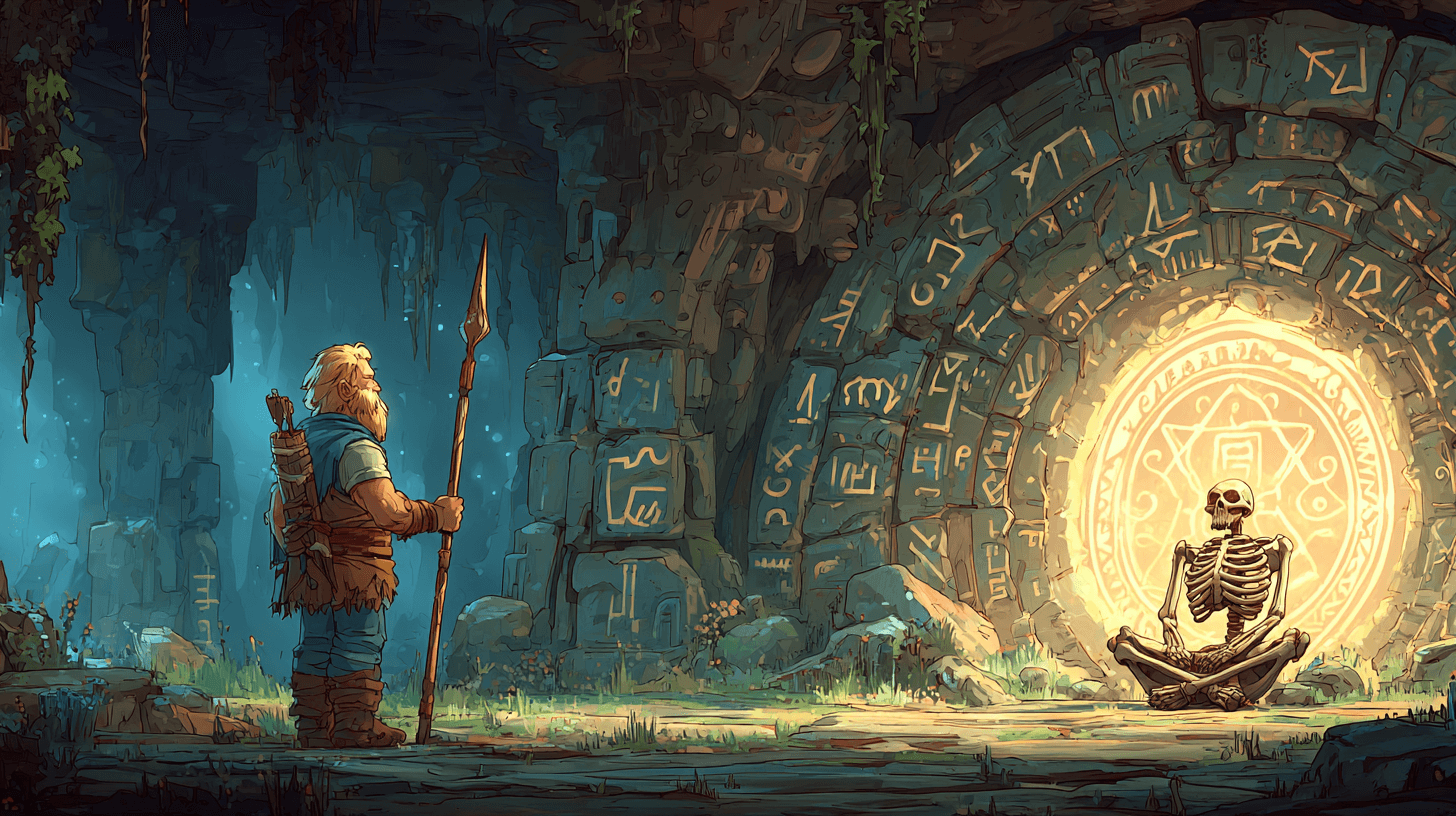
And in the center, seated on the bare stone floor, facing the far wall with its hands resting on its knees, was a dwarf.
What was left of one.
A skeleton. Old — the bones had the yellow-brown cast of real age, not years but centuries, the kind of old that means the world was different when this person was alive. But the bones were clean. Not picked clean by scavengers, not stripped by time and moisture. Clean. There was no dust on them. None. In a cave where every other surface carried a film of mineral dust and cobweb and the slow accumulation of underground years, these bones were immaculate.
Nothing had touched them. Nothing had come near them.
The wolves. The wolves had lived in this cave system for gods knew how long, and they had never come in here. Even corrupted. Even wrong. Even driven by whatever was leaking through this ward and twisting them into things with too many teeth and dead eyes. They had known better than to enter this room.
The skeleton was seated upright. Not slumped, not collapsed, not crumpled the way bodies fall when life leaves them. Seated. Formal. Deliberate. The way a runepriest sits when performing a working — I'd seen illustrations in the Academy library, in the old texts about deep traditions that nobody read except me and the librarian's cat. Legs crossed. Spine straight. Hands on knees. A position of focus. Of maintenance.
This dwarf had sat down. Assumed the position. And died.
And the working had continued. For centuries. The ward etched into every surface of this chamber had held — had kept holding — long after the priest who made it stopped breathing.
Until the wolves scratched through it.
I could see the damage now. Claw marks on the tunnel walls — not recent, but accumulated over years, decades, the slow patient erosion of animals drawn to this place and repelled by it in equal measure. They'd never entered the chamber. But they'd reached the edges. Scratched at the outermost runes. Hairline cracks ran through the carved symbols — tiny fractures where claw had met chisel mark and the chisel mark had lost. Not all of them. Not most. But enough. Enough to let something through.
The runes closest to the far wall were gouged deepest. Whatever the ward was holding back, the worst of it was there. On the other side.
I looked at the far wall.
Unmarked stone. Smooth. Natural. The only surface in the chamber that bore no runes, no chisel marks, no sign of the desperate work that covered everything else. Just rock.
But it hummed.
Not a sound. I want to be clear about that. My ears heard nothing. My teeth heard it. My bones heard it. The base of my skull, where the spine connects, vibrated with a frequency that wasn't frequency, a sound that wasn't sound, a presence that communicated itself through the stone and the air and the meat of my body without ever troubling my eardrums.
Something was behind that wall.
Something that had been there for a very long time. Something that the skeleton on the floor had died to keep contained. Something that had been seeping out, slow as groundwater, through the cracks in a failing ward — twisting wolves and rotting the land and reaching, reaching, always reaching—
Something patient.
Rensting's rune flared.
Not blue. White. A light so bright it burned my eyes and turned the chamber into a negative image — black stone, white runes, the skeleton's shadow thrown sharp against the far wall like a brand. Every rune in the chamber lit up at once, every carved symbol on every surface blazing with the same painful white light, and the chamber resonated.
A tone. A single, sustained note, felt more than heard. And I knew it. I recognized it.
The forge song. The song I'd sung — the song that had sung me — in Edric's farmyard two days ago. The song of the master smiths, of the deep forges, of hammer and metal and the mountain's pulse. The same tradition. The same root. The same voice that had poured out of me while I hammered iron into something better than iron, now echoing off the walls of a chamber carved by a dead runepriest who had sat here and held and held and held until there was nothing left of him but bones and will.
Then silence.
Then something behind the wall shifted.
Not moved. Shifted. The way a sleeping body shifts — a settling, a redistribution, the mechanical adjustment of something enormous becoming aware that something small was nearby. The hum changed pitch. The air thickened. The darkness at the edges surged inward. And the temperature dropped past cold into something that burned, a cold so absolute it felt like heat, and the silence after Rensting's flare was the loudest thing I have ever heard.
Louder than the Great Forge. Louder than the alpha's death scream. Louder than my own heartbeat, which was hammering so hard I could feel it in my fingertips and my tongue and the roots of my teeth.
Silence that listened.
My whole body was shaking. Some part of me — some deep, dwarven, stone-reading part that understood the language of caves and mountains and the things that live in the deep places — was screaming at me in a voice older than words. Not danger. Not run. Just wrong. Wrong in a way that went past fear into something more fundamental. A wrongness in the bones of the world itself.
I reached down. My hands found the skeleton's left hand — the one resting on its knee — and I saw the ring. A clan ring, heavy iron, worn on the third finger. I slid it off. The markings were unfamiliar — no clan I recognized, no symbols from any hold I'd studied. Old. The kind of old I didn't have context for.
And around the skeleton's neck, on a leather cord so ancient it crumbled at my touch: a key.
Iron. Heavy. Ornate. Dwarven-made — I could tell from the craftsmanship, the angular teeth, the weight and balance of it. A serious key, made for a serious lock, by a serious smith. I had no idea what it opened.
I took them both. Ring and key. Put them in my pocket with hands that wouldn't stop trembling.
And I backed out of the chamber without turning around.
Not because I thought something would follow me if I looked away. Because I knew — with the certainty of instinct, the certainty of stone and blood and the deep old knowledge that lives in every dwarf whether they want it or not — that if I turned around, if I looked at that far wall one more time, I would feel something reach back. Not with hands. Not with eyes. With whatever the hum was. And I would not be able to unfeel it.
Step. Step. Step. Backward. The worked stone under my feet. The chisel marks under my fingers. The air warming by degrees as I retreated through the tunnel. The hum fading. The silence loosening its grip, giving back the small ordinary sounds of dripping water and settling rock, sounds that had never been so welcome.
Then I was past the alpha's den, past the bone chamber, past the three wolves I'd killed. And the boar was there.
There. Right where I'd left it. Hooves planted. Shoulder bleeding. Head low, facing the tunnel I'd gone into. An expression that said it had been standing there the entire time — ready to come in after me if it had to, terrified to do so, and absolutely willing.
It huffed when it saw me. That sound. That low, rumbling, chest-deep grumm I'd been hearing for weeks — across the grassland, at the edge of the farm, in the yard during the long nights. The sound it made when it was saying I'm here and you're back and that was stupid all at once.
I sat down.
Not elegantly. My legs simply stopped working and I sat, hard, on the cave floor next to the boar. I put my hand on its bristled flank — the uninjured side — and felt it breathing. Warm. Solid. Real. The most real thing in the world, after that chamber. After the skeleton and the runes and the wall that hummed and the silence that listened.
"Grumm," I said.
The boar looked at me.
"That's your name," I said. "Grumm."
The boar huffed. Grumm. That exact sound. The one I'd just named it for.
It wasn't a name of power. It wasn't a name that would make ballad writers reach for their quills or historians nod approvingly in the margins of their chronicles. It was the sound a boar makes when it's annoyed, or hungry, or acknowledging your existence, or telling you it's been standing in a cave entrance for twenty minutes waiting for you to stop doing something idiotic.
But it was real. And after what I'd just seen — the dead dwarf and the broken ward and the thing behind the wall — real was what I needed. Not ancient. Not mysterious. Not a rune I didn't carve or a song I didn't learn or a skeleton sitting vigil over something I didn't understand. Just grumm. The sound. The boar. The constant, grumbling, complaining, stubborn, brave, wonderful animal that had followed me since the portal and charged wolves for me and held a tunnel for me and waited for me outside the worst room I'd ever been in.
Grumm.
It sounded, I realized, like rumbling. Like the deep vibration of the Rumbling Deeps that you feel in your bones and stop noticing because it's always there. Like home.
I did not cry. Dwarves don't cry. We have an alternative biological process involving internal moisture redistribution that happens to make the eyes water, and it is not the same thing, and I will fight anyone who says otherwise.
"Let's go, Grumm," I said, standing on legs that were not entirely reliable. "Let's go home."
I meant the farm. But also, I suppose, something else.
We came down the hill in the late afternoon, Grumm limping and me walking stiff-legged and both of us bloody and exhausted and alive. Mila saw us first — she always saw everything first — and she was running across the yard before Edric could catch her, screaming something that was probably my name but might have been a general declaration of ownership.
She hit my torso like a small, determined battering ram. I staggered but did not fall. Progress.
"Varg?" she demanded. "Varg, Borin?"
"Dead," I said. "Döda." One of Ren's words. Useful.
Mila looked at Grumm. At the blood. At the wounds. Her gap-toothed face crumpled in a way that suggested she was about to transition from excited to furious to crying without any of the intermediate stages.
"Grumm," she said — not the name, not yet, just the sound the boar made as it lowered itself painfully to the ground in the middle of the yard. She dropped beside it and put both hands on its broad head and began talking to it in a fast, serious stream of words I didn't understand, and Grumm let her. Just lay there, bleeding and breathing and somehow patient, while a seven-year-old told it off for getting hurt.
Edric reached me. He looked at the blood on Rensting's point. At my hands, which were still shaking. At my face — which must have looked like the face of someone who'd been somewhere they hadn't expected and come back changed.
He asked something. Several words. I caught hjälp — help — and okej — some things translate across any distance.
"Okej," I said. Then: "Not okay. But the wolves are dead."
He understood enough. The wolves were dead and we were alive, and for tonight, that was enough.
Halla came with water and cloth and something that smelled medicinal and stung when applied to Grumm's wounds. Grumm endured the treatment with the martyred patience of someone who had already survived worse today and was determined to make everyone feel guilty about the minor additional suffering. Ren helped me clean Rensting — carefully, silently, handing me rags without being asked, studying the rune with an expression that was half curiosity and half something older than curiosity.
I sat against the barn wall. The same spot where I'd sat after forging Rensting, two days ago. Same fading light. Same exhaustion settling into my bones like sand filling an hourglass.
Everything else was different.
In my pocket: a clan ring with markings I didn't recognize. A key with no lock.
In my head: a chamber where sound died and darkness pressed and a dead dwarf sat vigil over something that hummed through stone.
In my hands: a spear with a rune that had blazed white in a room full of ancient wards and resonated with a song I didn't learn and shouldn't know.
Rensting. Clean-Sting. I'd thought the name was about the mop, about the strikes, about the small precise puncture of a small weapon in the hands of a small, unremarkable dwarf. I wasn't sure anymore. The rune had lit up in that chamber like it recognized the place. Like it belonged to the same tradition as the wards on the walls and the dead runepriest on the floor. The forge song — my forge song, the one that had poured out of me — was the same song that echoed when Rensting flared.
Same tradition. Same root.
I didn't understand it. I wasn't sure I wanted to.
But I understood this: I was carrying a weapon connected to something old and deep and far beyond a student's accidental scribbling. And in my pocket was proof that a dwarf had once climbed this hill, carved wards into stone, and died keeping something sealed. Something that was still there. Something that was waking up.
Questions. So many questions. Who was the dead dwarf? What clan was the ring from? What did the key open? What was behind the wall? Why had the wolves gone wrong? What was the forge song, really? Why did I know it?
No answers. None. Just a boar named Grumm, a spear named Rensting, and the growing, uncomfortable suspicion that the world was much larger, much older, and much more dangerous than anything I'd learned in a library.
Mila climbed into my lap. She did this sometimes — unsolicited, without warning, like a cat claiming territory. She settled in, grabbed a fistful of my beard, and pointed at Grumm, who was lying on his side in the yard while Halla applied something that made him grunt in indignation.
"Grumm," she said.
She'd heard me say it on the hill. Of course she had. She heard everything.
"Grumm," I agreed.
"Bra namn," she said. Good name.
And it was.